


“Do you want to stop and check out a trail on the way?” I asked my spouse as we were preparing to move from a Superior National Forest to a Minnesota State Park campground at the start of the most recent government shutdown. “Which trail?” he asked. “Well, it’s been on my radar for some time, but there’s really not much information about it. It’s called the Birch Lake Trail,” I said, handing him my phone with a screenshot I’d captured years earlier. “That’s all the information I have,” I continued. “It could be a bust, but I’ve always wanted to check it out.” “Let’s do it,” he said. “You know I’m always down for a good pine forest.”
We finished packing up our vehicles and started our 30-minute drive to this little-known trail. After missing the turn into the parking area, we turned around, parked, and hopped out of our trucks. “That was a really beautiful drive,” I announced. “I know,” he agreed. “How come we’ve never been out here?” “I was just thinking the same thing,” I responded.
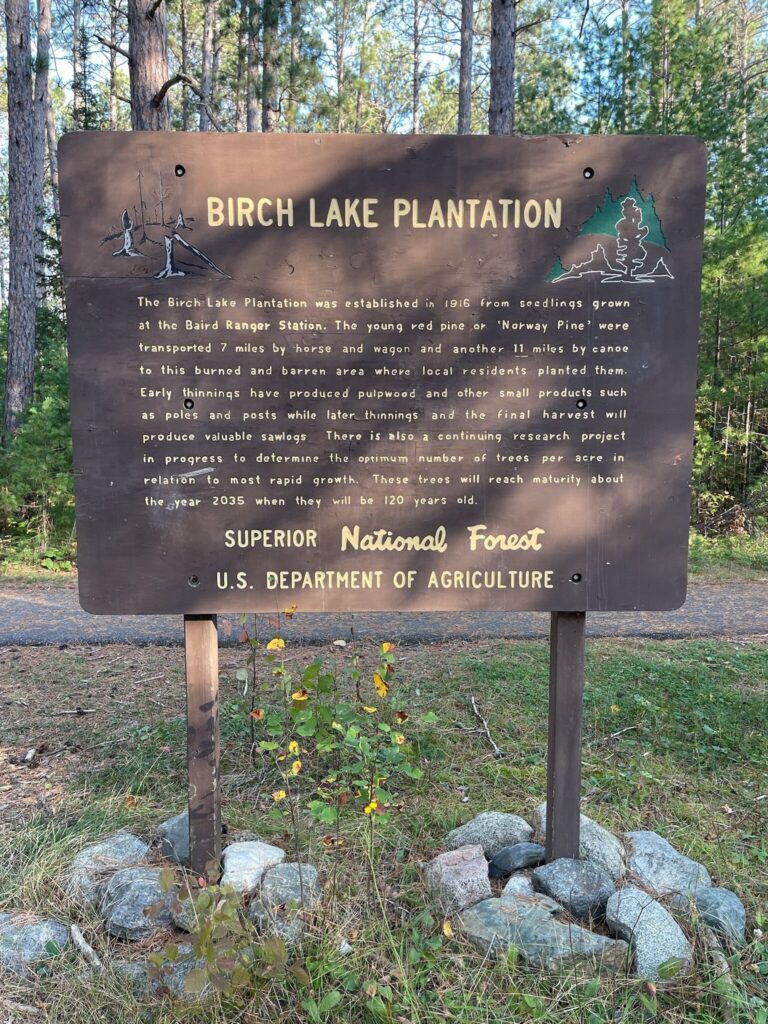
We grabbed some fruit to fuel up for our hike, then headed over to the interpretive sign near the parking area to learn about this hidden gem. The sign reads, “The Birch Lake Plantation was established in 1916 from seedlings grown at the Baird Ranger Station. The young red pine or ‘Norway Pine’ were transported 7 miles by horse and wagon and another 11 miles by canoe to this burned and barren area where local residents planted them. Early thinnings have produced pulpwood and other small products such as poles and posts while later thinnings and the final harvest will produce valuable sawlogs. There is also a continuing research project in progress to determine the optimum number of trees per acre in relation to most rapid growth. These trees will reach maturity about the year 2035 when they will be 120 years old.”
The history buff that he is, my husband filled me in on what was going on in 1915 when the seeds for the Superior National Forest’s first pine plantation were sprouting. The U.S. was about to enter World War I, and technology was advancing rapidly. The Wright brothers’ first powered flight took place just 12 years earlier, and the Model T launched five years after that. The way he described how people felt during this period reminded me of what many of us feel today as technology compounds at breakneck speeds.
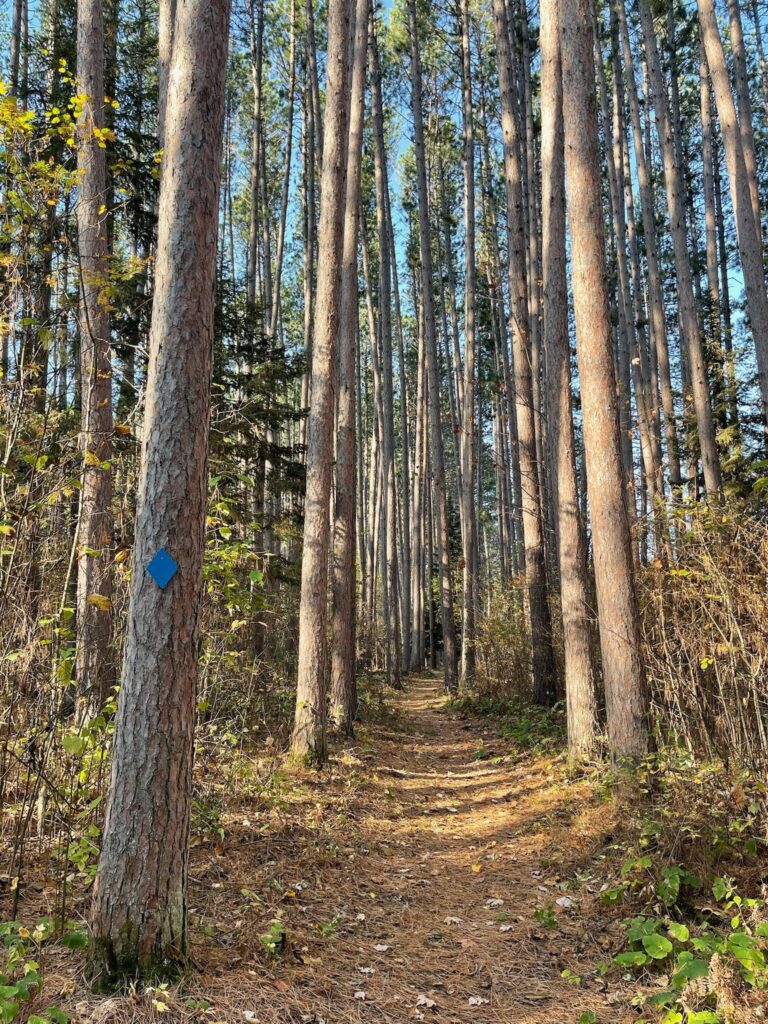
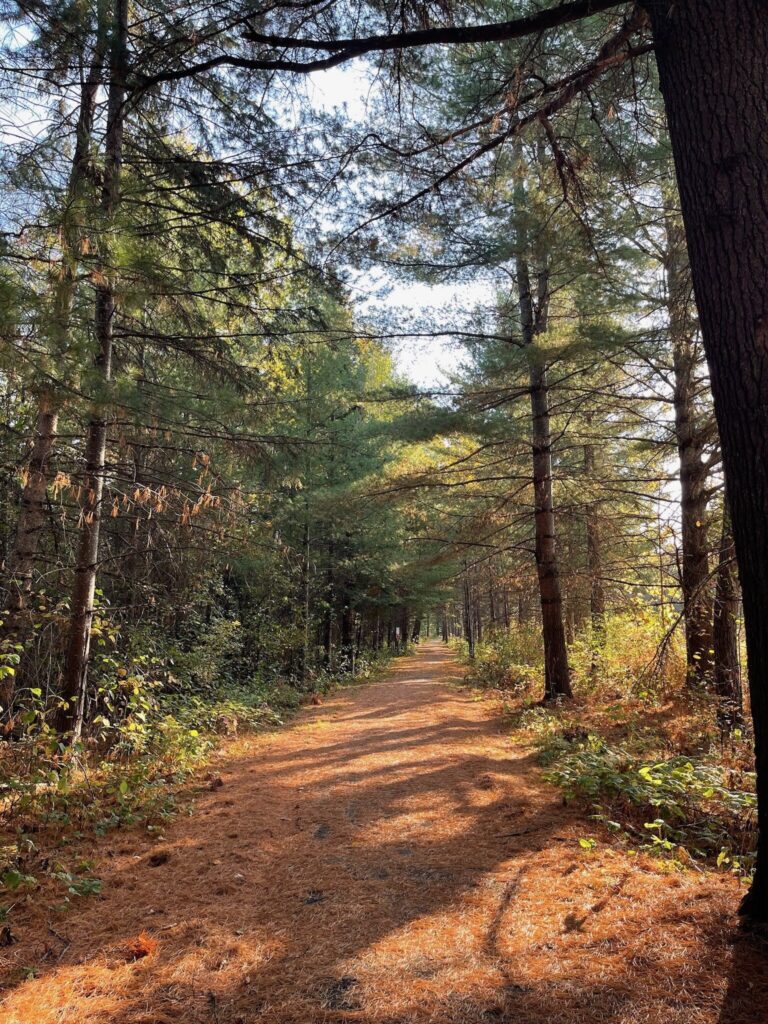
After a somewhat comforting same-as-ever moment, we studied the map and planned our route. We grabbed the day pack, and hit the trail. It was a beautiful fall day, warm enough to hike in shorts and t-shirts. The wind kept us cool and serenaded us with one of my favorite sounds—tall red pines swaying in the wind—nature’s most beloved wind chimes.
“You know that one of the primary functions of the Forest Service is to serve as a nursery of sorts?” I blurted out, interrupting the soothing sounds of the forest. “I guess I never considered that,” he replied, “but that makes sense.” It’s easy for us outdoorsy types to assume that the US Forest Service (USFS) just manages our federal recreation lands. But the Forest Service actually falls under the US Department of Agriculture (USDA). Established in 1905 “to provide quality water and timber for the nation’s benefit,” the USFS’ motto is “Caring for the Land and Serving the People.” Their mission is to “achieve quality land management under the sustainable multiple-use management concept to meet the diverse needs of people.” This means “protecting and managing the National Forests and Grasslands so they best demonstrate the sustainable multiple-use management concept.” That includes places like this that are used for research as well as commercial activities such as logging. The USFS manages 193 million acres of land, roughly the size of Texas. Here in Minnesota, 33% of the land is forested, and of those 17.7 million acres, more than 16% are federal—close to 3 million acres.
We continued our hike through the 120-acre plantation, stopping occasionally to pick up interesting colored leaves and capture photos of the sun filtering through the majestic trees. “It’s really the perfect tree for lumber,” my husband interjected after a long moment of silence. “Look. They’re almost perfectly straight,” he continued, “and they grow forever.” “I know,” I said. “That’s why they’re one of my favorite trees. They’re so resilient.”

The red pine—also known as the Norway Pine—was adopted as the state tree of Minnesota in 1953. One of the tougher trees out there, red pines can live to be 500 years old. Not only that, but both red and white pines have thick bark that insulates them from moderate-intensity fires that are necessary for forest health.
We made our way across Forest Road 131 to the west side of the plantation. We were excited to see some small rolling hills and more beautiful pine trees, clanging in the wind and soaking up the sunshine. As we made our way to the edge of the plantation, I pointed out a large stand of aspen trees. “You know that an aspen stand is one organism, right?” I asked my husband. “Yeah,” he replied. “There’s a stand somewhere in the US that’s one of the largest organisms in the world,” he continued.
Aspens are the most widespread tree in North America. A single aspen tree is only a small part of a much larger organism. A stand of aspen trees is considered a single organism with its main life force, an extensive, intertwined underground root system. Each tree in a stand is a genetic replication of the others. The oldest known stand can be found in Utah’s Fishlake National Forest and is estimated to be over 80,000 years old and weigh 6,600 tons. Even if a stand of aspens were wiped out, it is very difficult to permanently eradicate the root system due to the rapid rate it reproduces. Aspens thrive in a variety of environments, especially burn areas. This is evident throughout the footprint of the 2007 Ham Lake Fire along the Gunflint Trail. This is great news for Minnesota’s moose population, who can eat up to 40 pounds of twigs, leaves, and water plants per day.
As we made our way back to the paved trail that leads to the parking area, I asked my husband what he thought of the hike. “It was a pleasant surprise,” he said. “These shorter trails are often underwhelming. But this trail had just enough elevation to keep it interesting. And you know I always love a good pine forest. The aspen grove was also really cool. I’d do it again. Maybe with skis next time.”


How to Use the Birch Lake Plantation Trail

The Birch Lake Plantation Trail is open for hiking during the summer and fall and groomed for cross-country skiing in the winter. Never hike or snowshoe on groomed trails. A ski pass is required to use the trails in the winter. You can purchase them online here for $10 for a day, $25 annually, or a three-year pass for $70. They can also be purchased in person at Minnesota State Parks (Bear Head Lake and Lake Vermilion are the closest) or at any of the more than 1,700 locations that sell DNR permits and licenses. You’ll need a driver’s license or state ID to complete the transaction.
The trail is easy and suitable for all skill levels. The design of the trail makes it easy to build a route that fits your experience and fitness level. The area east of Forest Road 131 is flat. The area west of 131 is more challenging, but still easy enough for a novice skier like me.
When to Go
Like most trails in this region of Minnesota, the trail is lovely year-round. Obviously, if you plan to ski, you’ll want to do that in the winter. You can check trail conditions here. You can hike on the trails any time they’re not being used for skiing. Fall is a lovely time to visit and see the kaleidoscope of colors on the leaves falling from the aspen trees. And summer shows off its own rainbow of stunning wildflowers. If you can time it, visit on a windy day and enjoy the sound of nature’s wind chimes.
How to Get There
Birch Lake Plantation is located 17 miles south of Ely. From Highway 169 in downtown Ely, take County Road 21 south for 15 miles. When you arrive at County Road 70, turn left and continue 2 miles to County Road 623 through the town of Babbitt. You’ll see a small parking area on the left, 1 mile east of Babbitt, just past Forest Road 131.


