
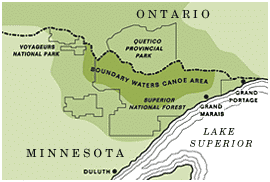
At outfitters across canoe country this week, the phones haven’t stopped. The Forest Service’s closure of the entire Boundary Waters — effective July 14, with no announced end date — has left thousands of paddlers without a trip and the businesses that outfit them scrambling: canceling and rerouting groups, issuing refunds, and finding new routes for visitors who flew in from Washington, New York, and California and can’t simply reschedule. How hard the closure lands depends a great deal on which side of the wilderness a business calls home.
Wilderness closed to visitors
Crews have been making their way into the Boundary Waters Canoe Area Wilderness (BWCAW) after the U.S. Forest Service-Superior National Forest (USFS) put a temporary closure on all entry points. They are seeking out visitors and asking them to leave the wilderness due to extremely hot, dry conditions and multiple wildfires. According to a Forest Service email to permit cooperators shared with Wilderness News, they are focusing on areas most susceptible to wildfire first.
Not all of the wilderness is burning, though. Most wildfires are located in the western region of the wilderness, north-northwest and east of Ely. As of July 14, the fire situation in the eastern region of the BWCAW has been much quieter. There have been reports of smoke along the Gunflint Trail and Grand Marais due to multiple fires in Quetico Provincial Park, just over the border.
Businesses appear stable on the eastern side
Tourism is part of the lifeblood of communities in the north. According to a recent report by the Minnesota Office of Outdoor Recreation, outdoor recreation generated approximately $1.35 billion in total economic output in northeastern Minnesota.
The BWCAW is the most visited wilderness area in the country, attracting more than 150,000 visitors each year. The majority of visits occur between May and September, driving demand for lodging, dining, outfitting, guiding, and other tourism services. Outfitters spend months planning, scheduling trips, updating equipment, and coordinating staffing.
Businesses on the eastern side of the wilderness appear to be faring better than those on the western side. Katie Kelley at Bearskin Lodge, located along the Gunflint Trail, told us there hasn’t been much impact on their day-to-day operations. “We feel fortunate that our lodging guests are able to continue carefully enjoying the rest of the Superior National Forest and North Shore despite the BWCA closure.” She went on to add that, “On the outfitting side, we have a handful of groups that we need to reschedule or entirely refund, or provide with alternative trip ideas outside the Wilderness.”
Sawbill Canoe Outfitters is helping its groups continue their adventures by exploring areas of the Superior National Forest outside the BWCAW. Owner Clare Shirley told us that, “For the immediate future, we are focused on finding alternate options in the Superior National Forest for the groups that are already on site or en route in an attempt to salvage their trips. We have people here from Washington state, New York, California, etc who have flown in and cannot simply reschedule.” She said if they can’t find alternatives for folks, then Sawbill will cancel their reservations and refund their deposits.
Sawbill Canoe Outfitters is also telling folks with trips scheduled after Friday to wait and stay flexible until they know more from the USFS. Shirley added, “There are no fires burning near or threatening the Sawbill area. We are hopeful that if the closure extends beyond Friday, day trips will be allowed, given that there is no imminent danger or threat in our vicinity.”
Get Fire Updates
Stay informed on recent wildfires, campfire bans, park closures, straight to your inbox.

Outfitters on the western side feeling the strain
Piragis Northwoods Co., one of the larger outfitters in Ely, said in a post that they’re working hard to contact their groups scheduled to come this week. “As you can imagine, our Outfitting Department is doing its best… We are answering phones and taking messages and returning them as best we can.” They and many other operators on the western side have been scrambling to notify groups.
Staff at Piragis also mentioned that they’re taking it one day at a time. They’ve been telling folks to give it a week, and then they’ll have a better idea of conditions and closure. They remained optimistic, noting that they’ve been in the business long enough to have survived a pandemic and other wildfires. With the forecast looking more promising, they feel that the next 48-72 hours will be telling.
Voyageur North is encouraging people not to cancel their trip. Instead, they’re recommending people do a backcountry canoe route that’s outside the wilderness boundary. They posted that “We know many back-country routes that are very similar in look and feel to a BWCA site.”
While many people will need refunds, outfitters hope some can find alternative options or reschedule. It’s too early to tell the total economic impact, though. One outfitter said it could be significant because they have to refund so many parties.


Closure focuses on public safety
In a social media post, the Forest Service said that the decision behind the emergency order is to keep everyone safe. “The closure will remain in effect until the fires are contained and the risk to the public has decreased. We know how important the Boundary Waters is to local communities and the more than 150,000 people who visit each year, and we appreciate your patience as we work to restore safe conditions.” Staffing shortages and limited resources have stretched the USFS thin, making this an especially challenging time for the agency
Unseasonably warm and dry weather will continue until Wednesday. Evacuations are underway. The entire wilderness last closed because of fires in August 2021.

More info:
- WatchDuty – Wildfire Maps & Alerts
- Ontario Forest Fire Info Map
- 2026 Minnesota Outdoor Recreation Economic Impact Report