
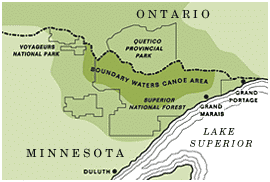
Minnesota Governor Tim Walz issued Executive Order 26-10 on Tuesday, August 18, which takes a number of actions to prevent nonferrous mineral mining within Minnesota’s Rainy River Headwaters Watershed. The watershed holds mineral deposits under a mix of private, state and federal ownership, with some of the lowest water pollutant levels and highest quality fisheries in the state.
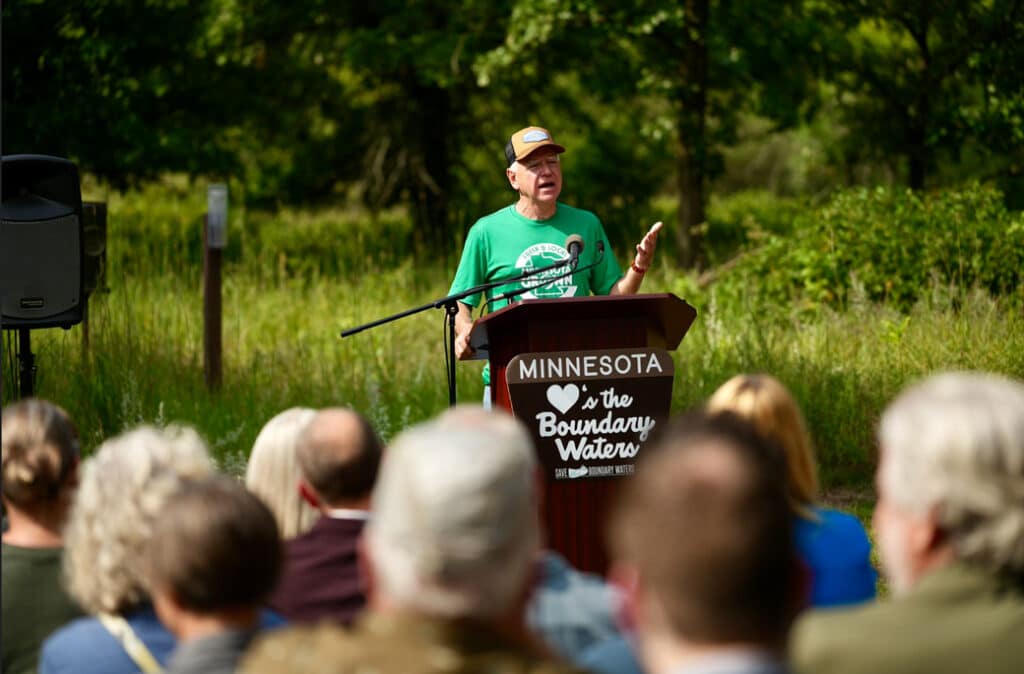
Announcing the order, Walz called the Boundary Waters “a national treasure” and said: “It’s our duty as Minnesotans to ensure the sacred place remains wild, pristine and unharmed.”
What the order does
The order tells two state agencies — the Minnesota Department of Natural Resources (DNR) and the Minnesota Pollution Control Agency (MPCA) — to stop work on copper-nickel mining proposals in the watershed. Neither agency will conduct environmental reviews or issue permits while a lawsuit questioning whether Minnesota’s mining rules are strong enough to protect the Boundary Waters, Northeastern Minnesotans for Wilderness v. DNR, remains unresolved. The MPCA’s pause also lasts until it finishes writing new rules.
Agencies are required to cut off state cooperation with any federal environmental review of any nonferrous mine proposals in the watershed, and to stop new mineral leases there. It also stops new state surface leases for nonferrous mining activities, and puts every existing state lease in the watershed under scrutiny by directing state agencies to enforce compliance with current lease terms to the fullest extent the law allows.
Finally, Walz’s order directs the DNR to draft legislation that would permanently ban nonferrous mining in the watershed, for the Minnesota Legislature to take up in 2027. While in Ely, Gov. Walz also asked lawmakers to make an Ely-area economic recovery package their “first order of business when they return in January.” The proposed package is intended to help the region recover from this summer’s wildfires and the closure of much of the BWCAW.
A proclamation in Ely
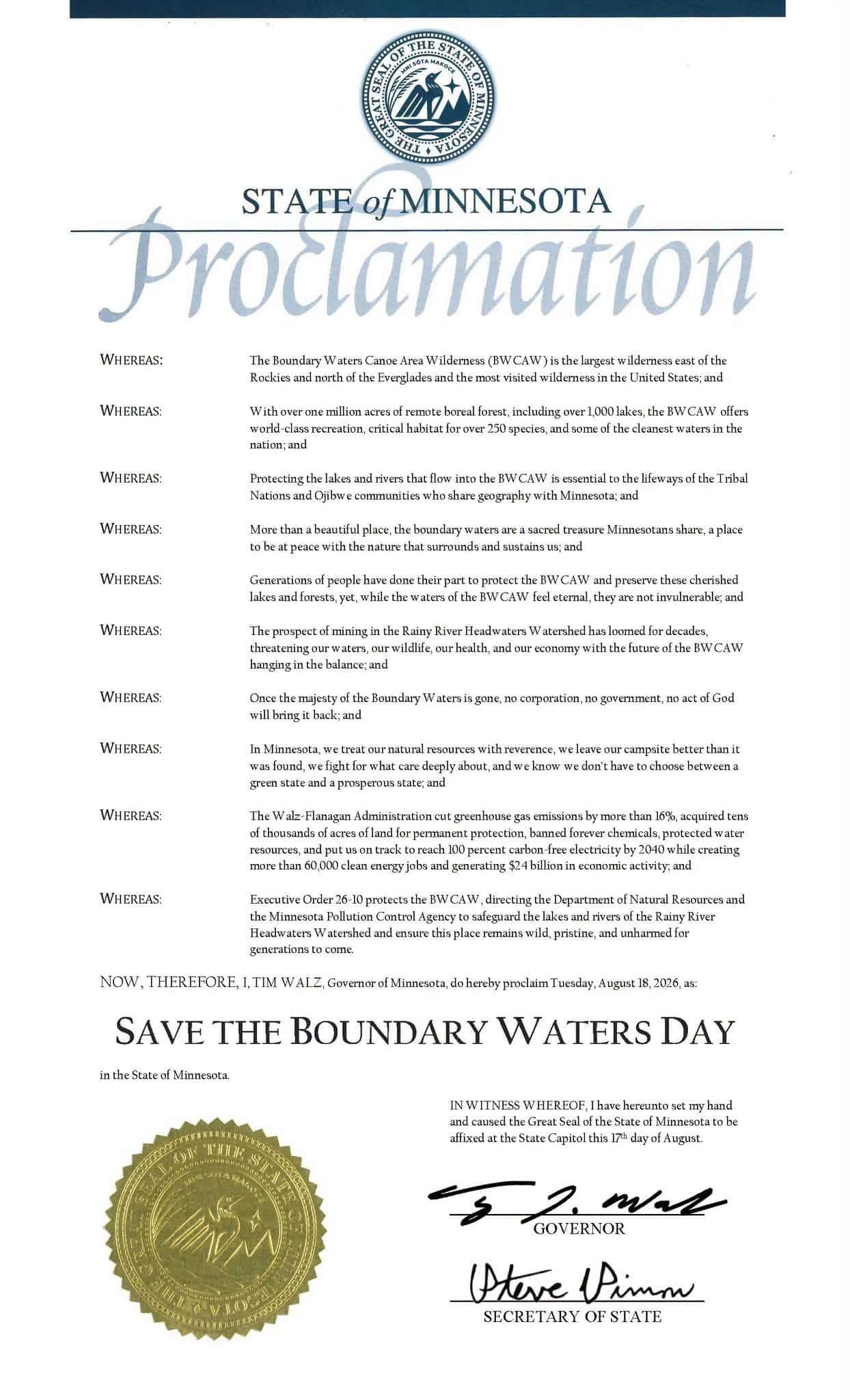
Following the order, Governor Walz traveled to the town of Ely, on the edge of the Boundary Waters, and made a separate proclamation of August 18 as “Save the Boundary Waters Day” in Minnesota. As reported by Fox 21, Walz spoke to local residents at the Ely Folk School: “I think the moves that the federal government was making to try and go around the will of the people, the will of the science, we just wanted to make sure in Minnesota that ended today,” Walz told Ely residents.
Conservation groups welcome the order
The Minnesota Center for Environmental Advocacy issued a statement to Quetico Superior Wilderness News applauding Walz’s decision. Kathryn Hoffman, MCEA Executive Director, stated: “Thank you, Governor Walz, for taking executive action to protect the Boundary Waters wilderness from the dire threat sulfide mining pollution poses to water quality and the natural resources we share with Ojibwe people through treaties. Since the federal government has abdicated their responsibility to protect these shared water resources, it’s up to us to protect Minnesota’s water.”
Another organization to come out in support of Governor Walz’s order was Friends of the Boundary Waters Wilderness. Chris Knopf, the organization’s executive director, gave the following statement to Quetico Superior Wilderness News: “This happened because Minnesotans refused to be quiet. They wrote, testified, and kept showing up. Governor Walz listened, and he acted. Walz made it clear that federal overreach will not decide the fate of Minnesota’s waters. He defended what is best about this state. This is the kind of action a governor is remembered for.”
Critics call it executive overreach
Pete Stauber, who represents Minnesota’s 8th Congressional District in the United States House of Representatives, led the Congressional Review Act resolution that repealed the 20-year federal withdrawal instituted by the Biden Administration. Stauber gave his views in a statement on his website: “It is disappointing, yet unsurprising to learn that Governor Walz has launched a spiteful and harmful attack against the hardworking people of the Iron Range. His radical, job killing executive order puts thousands of family-supporting union jobs at risk and ignores the will of those who actually live and work in Northern Minnesota.”
Opposition also came from inside Walz’s own party. DFL state Sen. Grant Hauschild, who is running for re-election in District 3, objected to the order. “I strongly disagree with Governor Walz’s decision to ban non-ferrous mining in the Rainy River Watershed,” said Hauschild in a post to his Facebook page. “A decision this significant to the people of the Northland should not be made through executive order by a Governor who leaves office in a matter of months.”
Mining company responds
Twin Metals Minnesota, the company behind a proposed underground copper-nickel mine near Birch Lake — roughly five miles from the Boundary Waters and just southeast of Ely — pointed to the state’s own findings. In a statement reported by the Mesabi Tribune, Kathy Graul, the company’s director of public affairs, said that “as an April 2026 legal decision by the Minnesota Department of Natural Resources (DNR) makes clear, our state’s existing environmental laws are strong enough to protect the waters of the Boundary Waters Canoe Area Wilderness (BWCAW) and the Rainy River Headwaters Watershed from pollution, impairment or destruction.” The order, Graul said, “directly contradicts these independent findings and unnecessarily hinders the responsible development of Minnesota’s natural resources.”
Ruling in April in the six-year case brought by Northeastern Minnesotans for Wilderness, the DNR found in a 74-page decision that the state’s nonferrous mining siting rule “is largely protective” and adequate to protect the BWCAW from water, air and other impacts of nonferrous mining — except as to potential noise and light impacts.

The Boundary Waters, delivered weekly
Join thousands of readers receiving free wilderness news and weekly updates from the Northwoods.
Not a law, and not yet in force
Governor Walz’s executive order is not a law. It can be undone by a future state administration the same way it was created — with a signature, not a legislative vote. The order is not yet in force: by its own terms it takes effect fifteen days after publication in the State Register and filing with the Secretary of State. Once in effect, it stands until it is rescinded by proper authority, or until it expires under state law — 90 days after the governor leaves office. Walz leaves office in January 2027.
More info:
- Executive Order 26-10 (signed)
- Ely Echo: Walz takes executive action to ban nonferrous mining in Boundary Waters watershed
- Fox 21: Gov. Walz visits Ely after signing executive order for BWCAW mining ban
- Northern News Now: Gov. Walz proclaims August 18 ‘Save the Boundary Waters Day’
- MinnPost: Walz halts state action on Twin Metals, but federal process still on track
- Mesabi Tribune: Walz issues order on BWCAW mining