Invasive species tend to have names that make you cringe. Take spiny water flea, for example—a common invasive in Minnesota, including some Boundary Waters lakes. Or rusty crayfish. Now, a new invasive species—bloody red shrimp—has been found in the Lake Superior ecosystem, and its name suggests danger. So are these tiny shrimp, which first hitched a ride to the Great Lakes via ballast water from contaminated transoceanic cargo ships, a threat to Lake Superior and surrounding waters? How so?
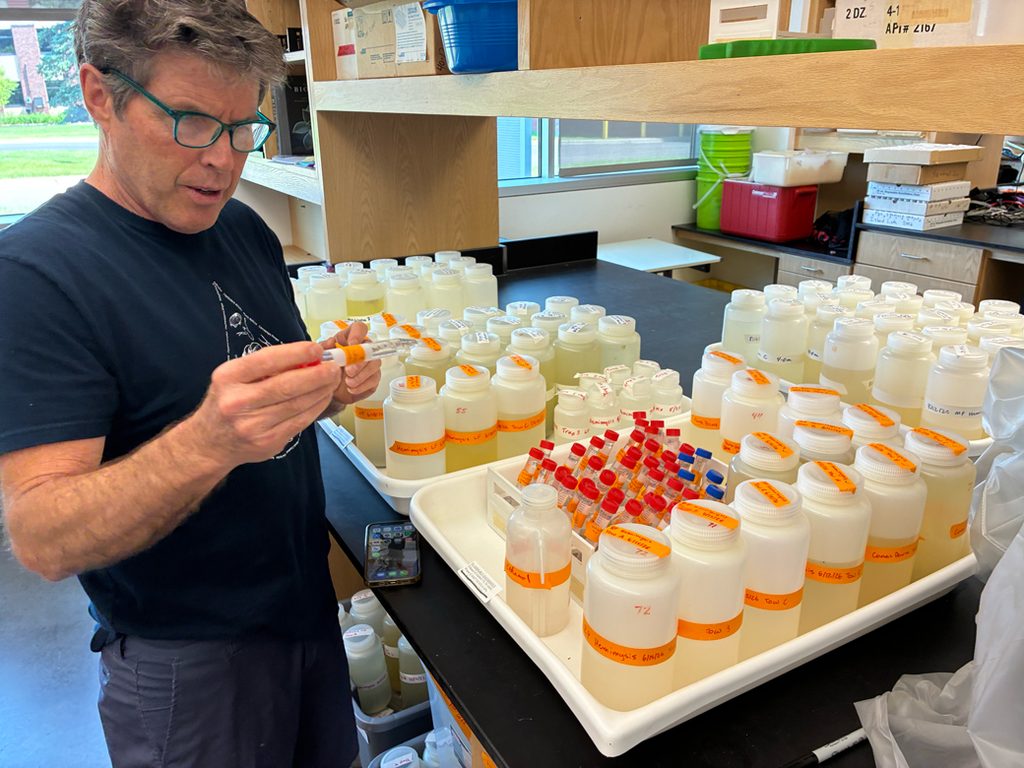
“The name is just eye-popping,” quips Dr. Donn Branstrator, Professor of Biology at the University of Minnesota Duluth. Branstrator is a leading researcher on invasive species in Lake Superior and surrounding water bodies. He’s been studying spiny water flea his whole career, but he recently added bloody red shrimp to his field work. Bloody red shrimp were first identified in the Duluth-Superior Harbor in 2017 and 2018, and are now being studied intensely by Branstrator and his students.
Branstrator, together with graduate student Kristin Huelsbeck and a team of researchers, published a paper in the Journal of Great Lakes Research in February, 2026 entitled “First evidence of Hemimysis anomala (bloody red shrimp) establishment in Lake Superior.” The paper reports how Branstrator’s team found the presence of bloody red shrimp of all ages at two different locations in the Duluth-Superior Harbor in their 2025 field work.
Bloody red shrimp’s descriptive common name stems from chromatophores that can be found in Hemimysis. Chromatophores are specialized pigment-containing and light-reflecting cells found in a wide range of animals. They’re not actually blood cells though, therefore making the bloody red shrimp’s name misleading. “Their common name differentiates them from native shrimp,” notes Branstrator.
A key native species in Lake Superior is opossum shrimp (Mysis diluviana)—a critical part of the lake’s offshore food web. Those shrimp live in Lake Superior’s deep, dark, cold water. They are a main food source for juvenile lake trout, as well as smaller lake trout morphotypes, like humpers, which live on offshore humps.


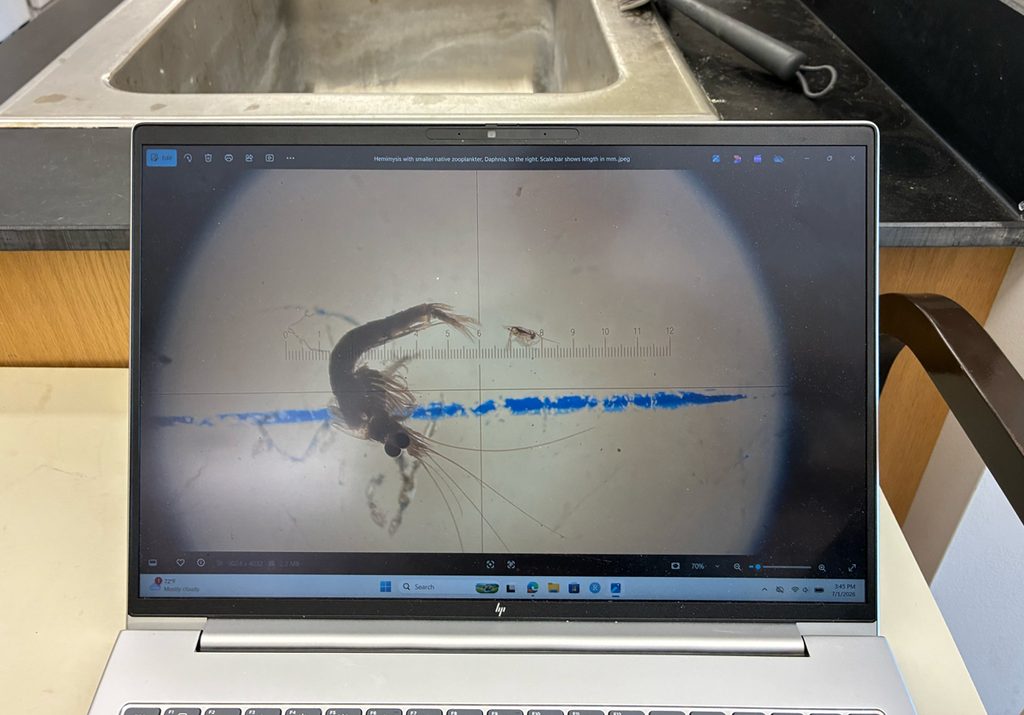
The two shrimp species can be very hard to differentiate. Opossum shrimp has a forked telson (the terminal segment to the abdomen) while the bloody red shrimp has a truncated telson. “You have to look at the structure of the telson to definitively separate Hemimysis from the native species,” explains Branstrator. He and his team must examine each shrimp they collect under a microscope to properly identify the species.
So what does Hemimysis anomala look like? “Honestly, they look like shrimp you’d eat in a restaurant, but they’re a lot smaller,” explains Branstrator, as he shows a collection of samples in his team’s lab at UMD. The shrimp are about the size of a human fingernail: visible to the human eye, but only if you know what you’re looking for.
“In the world of zooplankton, they’re big,” says Branstrator. “They’re essentially macroscopic. However, the casual person might not even recognize hemimysis at the bottom of a bait bucket, or on their canoe,” Branstrator adds.
This low visibility is adaptive. “Bloody red shrimp, like a lot of zooplankton, tend to be very transparent and colorless,” explains Branstrator. “It helps protect them from fish by making them less visible. We have found a few that are somewhat red, but that red tint comes and goes.”
Shrimp overwinter in the harbor
One of the research team’s main discoveries this spring was that Hemimysis had likely overwintered in the Duluth-Superior Harbor. “We went out a week after ice out to the same location where we had been finding swarms the previous season. We found them again, before many ships were coming into the harbor for the new season,” recounts Branstrator. According to the MN DNR, bloody red shrimp prefer warmer water temperatures of 50–70° F, but now Branstrator and his team have strong evidence that Hemimysis can live under the ice.
While Hemimysis is native to the Black and Caspian seas, which don’t freeze over in winter, bloody red shrimp are highly adaptable, overall. Invasive species, Branstrator points out, are typically “generalists, not specialists,” and are tolerant of multiple environments.
So how do Branstrator and his students catch Hemimysis? The research team goes out sampling a site in the Duluth-Superior Harbor once every two weeks, April through September. Kristin Huelsbeck also goes to five other sites, once in June, and once in July. Branstrator calls his whole team “nightcrawlers,” because they do all their sampling work at night. “Nobody sees us,” he laughs. Hemimysis avoid bright light, commonly staying on bottom during the day, then rising at night to feed. According to the MN DNR, “they may be seen as reddish-colored ‘swarms’ near structures such as breakwaters and piers.”


The UMD researchers have designed special zooplankton nets and funnel traps to do their sampling. “My students made these,” explains Branstrator, “based on published best practice.” Why both nets and traps? “The traps are biased to catch juveniles, so you really only catch juveniles in them,” says Huelsbeck, “while the nets collect both juveniles and adults.”
“The traps are easier from an operational standpoint,” Branstrator notes. “You can go out there in the evening, deploy it, tie it into the rocks, and come back the next morning. A little bit more agreeable to the human sleep cycle,” he laughs. “With nets, you pull the net through a certain expanse of water, and you can estimate how much water went through that net—a cylinder of water. Then, you can back-calculate abundances.”
So how established is Hemimysis in the Duluth-Superior Harbor? “It’s here,” says Branstrator. “It’s here in enough numbers that we can make a reasonable conclusion that it’s self-sustaining.” The researchers have found individuals at different locations in the harbor, and at all three life stages, including newborn shrimp just 1 to 2 mm long, which then grow to maturity in a month. They’ve found males and females, including reproductive females.
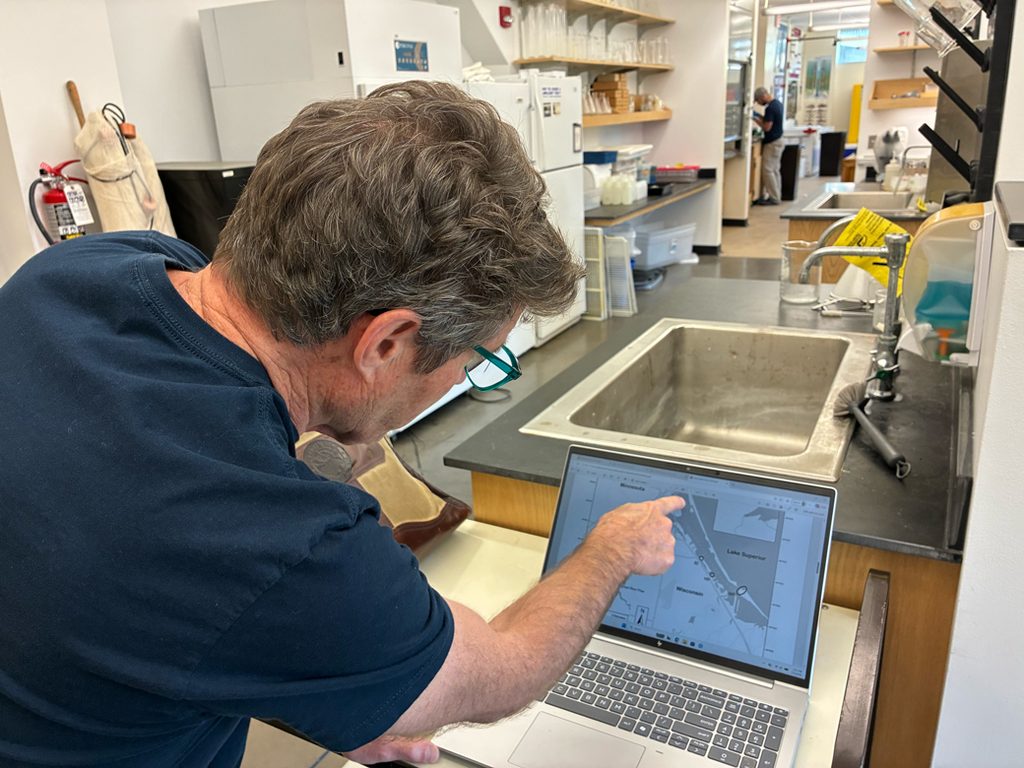
So are bloody red shrimp actually in Lake Superior itself? For Branstrator, “the harbor and Lake Superior are almost one body of water as a result of seiche activity.” That said, Branstrator’s team hasn’t tried sampling in Lake Superior itself. The closest they’ve come to the lake is the bouldered breakwall on Wisconsin Point that lines the Superior entry to Lake Superior. “You could throw a stone from there to Lake Superior. That’s as far out as we’ve gone,” explains Branstrator.
The last of the Great Lakes to be invaded
In their research paper, Branstator and team note that Lake Superior is the last of the Great Lakes to be colonized by hemimysis: “Lake Superior now becomes the fifth and final Great Lake in which H. anomala is considered established. This follows a range expansion that began with Lakes Ontario and Erie in 2006 and progressed to Lakes Huron and Michigan by 2008 (Marty et al., 2010; Pothoven et al., 2007; Walsh et al., 2010). The delayed establishment in Lake Superior is notable and may reflect barriers such as colder temperatures and geographic isolation (Ricciardi et al., 2012).”
Can Hemimysis outcompete native zooplankton? “There’s no evidence of this yet, but it’s reasonable to predict that it’s possible, on a few different grounds,” says Branstrator. “A lot of the evidence from The Netherlands, where invasive Hemimysis have colonized reservoirs, shows that once they arrive, the densities of native zooplankton collapse. Bloody red shrimp feed as juveniles on algae, but progressively they transition to feeding on native zooplankton that are the filter feeders out there. The zooplankton control the algae, so if you remove the filter feeders, now the algae can prosper. You might get residual effects in terms of water clarity.”
Branstrator is quick to add that there’s been no documentation thus far of a clear connection between Hemimysis thriving in the lower Great Lakes and big disruptions in the native zooplankton, or secondary shifts in algae. “We just haven’t seen it yet, but that might be for a variety of reasons,” continues Branstrator. “There’s nothing that’s gone on in the lower Great Lakes to suggest we should be alarmed. We just need to be aware there’s a new addition here.
One interesting possibility is that bloody red shrimp could become a novel food source for local fish, such as walleye, perch, or sturgeon. “There’s evidence that they’re nutritious, says Branstrator. “Maybe as much or more nutritious than native zooplankton.” This suggests local fish could potentially benefit from the introduction of hemimysis, if they can feed on the shrimp among the rocks.
The threat to native species is unclear
With much still to discover, Dr. Branstrator, Kristin Huelsbeck (in her second year of graduate school) and three fellow student assistants are busy at work this summer sampling and analyzing bloody red shrimp. Huelsbeck is currently comparing Hemimysis densities to some of the native predatory zooplankton, like Leptodora, Polyphemus, and Chaoborus in the Duluth-Superior Harbor, to get a sense of what the addition of Hemimysis means for that guild of predators. On one occasion Huelsbeck sampled both a native opossum shrimp and an invasive bloody red shrimp in the same net.
“Before we make final conclusions about good, bad, or otherwise with Hemimysis, we have to let the situation play out. We have to let the ecosystem equilibrate,” says Branstrator. “This has been one of the real challenges with the Great Lakes: we have just one wave of non-natives after another. So to get a clean slate for enough time to ascribe outcomes to one versus another species has been a challenge.”

The Boundary Waters, delivered weekly
Join thousands of readers receiving free wilderness news and weekly updates from the Northwoods.
Waiting may reveal that hemimysis are just an incremental addition to the ecosystem—abundances are small. Or hemimysis could have multiple effects that basically balance out in the end. Finally, it may be impossible for scientists to measure their contribution above and beyond “variation and noise in the system,” Branstrator says.
And could Hemimysis also spread to inland lakes? “It has the potential,” Branstrator thinks. “They’re in Oneida Lake in New York, and in Seneca Lake. They’ve spread through the canal systems there. This is news to just double down on Clean, Drain, Dry, and be vigilant and persistent.”
How to stop the spread
Having spent his whole career studying invasive species, Branstrator is a big fan of Clean, Drain, Dry. “It’s working to stop the spread of spiny water flea. In 2014, the MN Legislature began appropriating millions of dollars annually to aquatic invasive species prevention. When they did, the numbers of new lakes infested by zebra mussels, spiny water flea, you name it, just started to flatten.”
As Branstrator and his students head back to the harbor’s dark waters this season, they’ll keep pulling their nets and checking their traps. The bloody red shrimp is officially here to stay, and what that means for the food web of the greatest of the Great Lakes is a story being written under the microscope.