
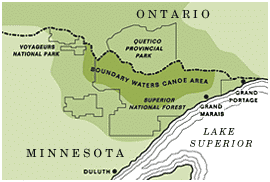
The fight over mining near the Boundary Waters Canoe Area Wilderness has reached a critical turning point as the U.S. Senate prepares to take up H.J. Res. 140. This resolution seeks to overturn the 20-year mineral withdrawal that currently protects roughly 225,000 acres of the Superior National Forest within the Rainy River watershed.
The U.S. House passed the resolution on January 21, 2026. Because it is being advanced under the Congressional Review Act, it requires only a simple majority to pass the Senate. With the vote approaching, advocacy groups have escalated pressure at both the federal and state levels through a series of high-profile events in St. Paul.
February 18: press conference with Senator Tina Smith
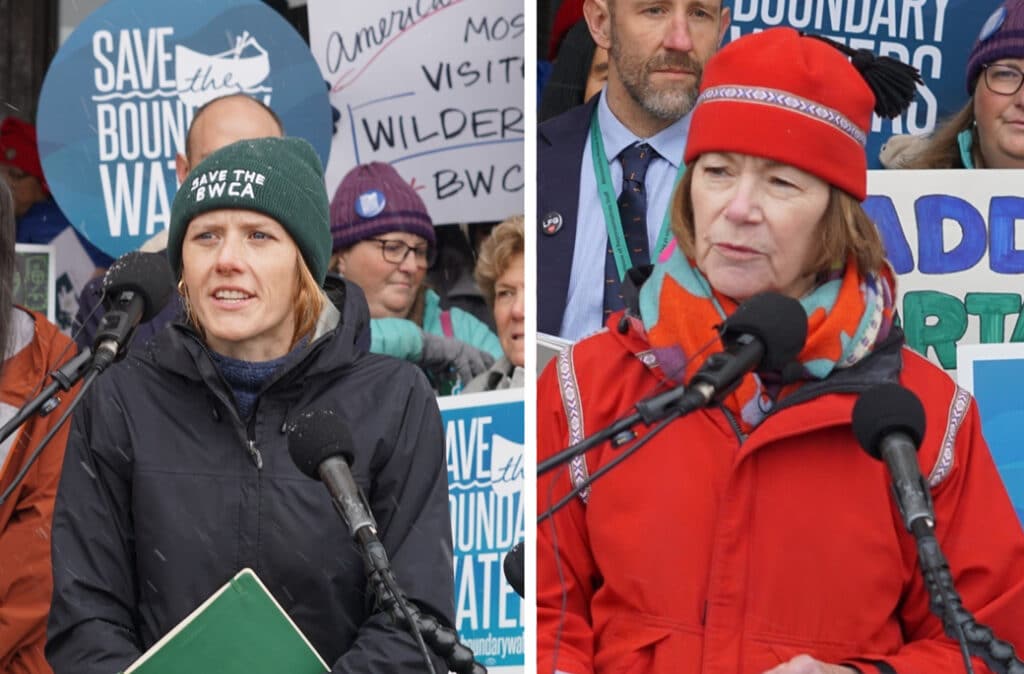
On February 18, Save the Boundary Waters held a press conference at the Minnesota State Capitol alongside U.S. Senator Tina Smith and a broad coalition of leaders from the hunting, fishing, business, and legislative communities.
Organized ahead of the “unprecedented” Senate vote, the event featured voices including Ron Monson of Sportsmen for the Boundary Waters, Jason Zabokrtsky of Ely Outfitting Company, and State Legislators Steve Cwodzinski, Liish Kozlowski, and Alex Falconer. The coalition emphasized a singular truth: the proposed mine site sits in a lake-filled region where water flows north into the Boundary Waters. In such an environment, pollution in one area can rapidly compromise the entire 1.1 million-acre system.
February 25: “Day of Action” draws hundreds
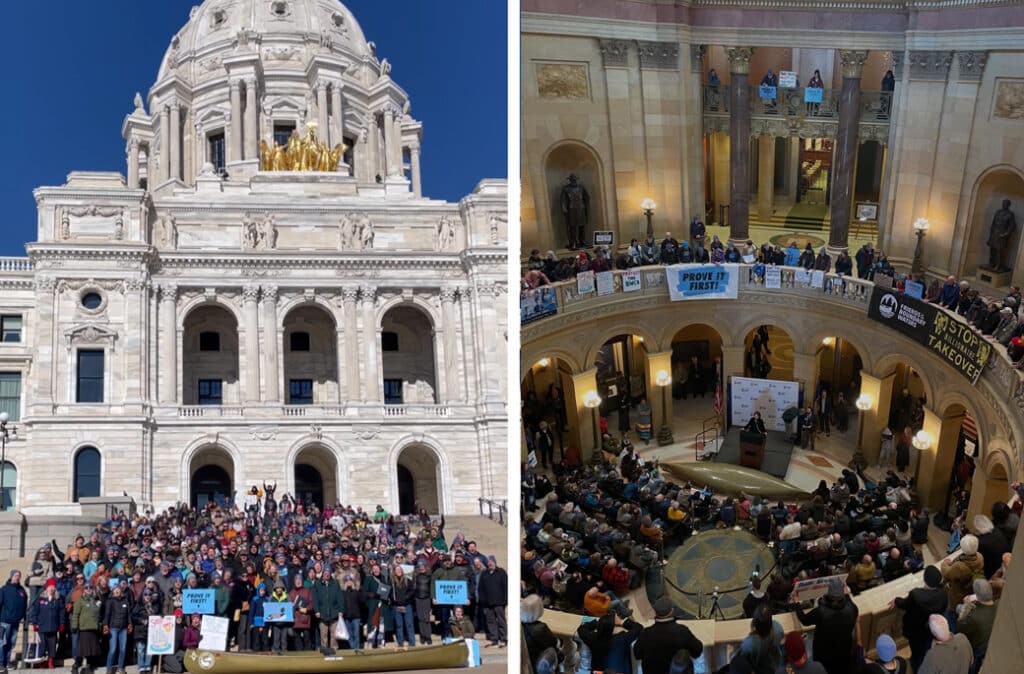
The momentum continued on February 25, when hundreds of wilderness defenders gathered at the Capitol for a “Day of Action” organized by Friends of the Boundary Waters Wilderness and allied groups.
At the rally, Chris Knopf, Executive Director of Friends of the Boundary Waters Wilderness, underscored the high stakes: “If pollution gets in one part, it makes its way all throughout the entire ecosystem.” Organizers framed the day as both a direct appeal to the U.S. Senate and a reminder that Minnesota possesses its own legal authority to influence the future of the Twin Metals project.
The Federal stakes
The mineral withdrawal, finalized in January 2023, removed federal lands in the Rainy River watershed from new mineral leasing for 20 years. If H.J. Res. 140 passes the Senate and is signed into law, this withdrawal would be rescinded. Critically, under the Congressional Review Act, similar protections could not be reissued in “substantially the same form” in the future without new congressional authorization.
Advocacy groups warn that Senate scheduling can happen with as little as 24 hours’ notice and are urging supporters to contact lawmakers immediately.
Minnesota’s potential role: the Twin Metals lease
While the federal vote looms, Friends of the Boundary Waters Wilderness has highlighted a state-level pathway involving Twin Metals’ mineral lease with the State of Minnesota.
Friends argues that a provision in the company’s 1990 state mineral lease creates a review opportunity in 2026—the lease’s 36th year. Under the terms, the state may have the right to cancel the lease if certain conditions have not been met, including:
- Actively engaging in mining.
- Paying at least $100,000 in royalties in a single calendar year.
According to Friends, Twin Metals has met neither requirement. Because a significant portion of the proposed ore body lies beneath state-owned mineral interests, state action could profoundly affect the project’s viability. The Minnesota Department of Natural Resources (DNR) has not yet announced a decision regarding the lease, as any cancellation would depend on a rigorous administrative review of lease language and state law.
The watershed at stake
The Boundary Waters is a singular landscape of interconnected lakes, rivers, and forests. Opponents of sulfide-ore copper mining argue that the risk of acid mine drainage makes this location uniquely vulnerable, while supporters maintain that modern regulations can manage environmental risks.
As the Senate prepares to decide whether the federal protection stands, the voices heard this month in St. Paul make it clear: the future of the BWCA remains one of the most consequential environmental issues facing the state and the nation.
How to take action
From Save the Boundary Waters:
The organization is urging supporters nationwide to contact U.S. Senators to oppose H.J. Res. 140. Through their Action Center, you can:
- Call your U.S. Senators and urge a “NO” vote.
- Share resources with friends and family in other states to expand the coalition.
From Friends of the Boundary Waters Wilderness:
The Friends are focused on Minnesota’s authority over state mineral leases and long-term policy. Supporters are encouraged to:
- Contact DNR Commissioner Sarah Strommen to request a review of the Twin Metals state mineral lease via their direct action form.
- Support the “Prove It First” standard, ensuring no copper-nickel mine opens until it is proven safe.
More Info
- Congress Takes Unprecedented Steps to Overturn 20-Year Mining Ban Near BWCA
- Capitol Day of Action Report (KARE 11)
- Toxic Sulfide Mining Near the BWCA (Friends of the Boundary Waters Wilderness)