
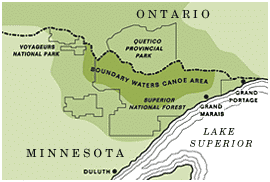

Often called “forever chemicals,” per- and polyfluoroalkyl substances (PFAS) have been detected throughout the Great Lakes basin — in rain, air, water, sediment, and fish — raising concerns about ecosystem and human health. Recent research adds an important new chapter to this story: while PFAS contamination remains widespread, long-term data suggest that levels in fish are declining, even as atmospheric deposition continues.
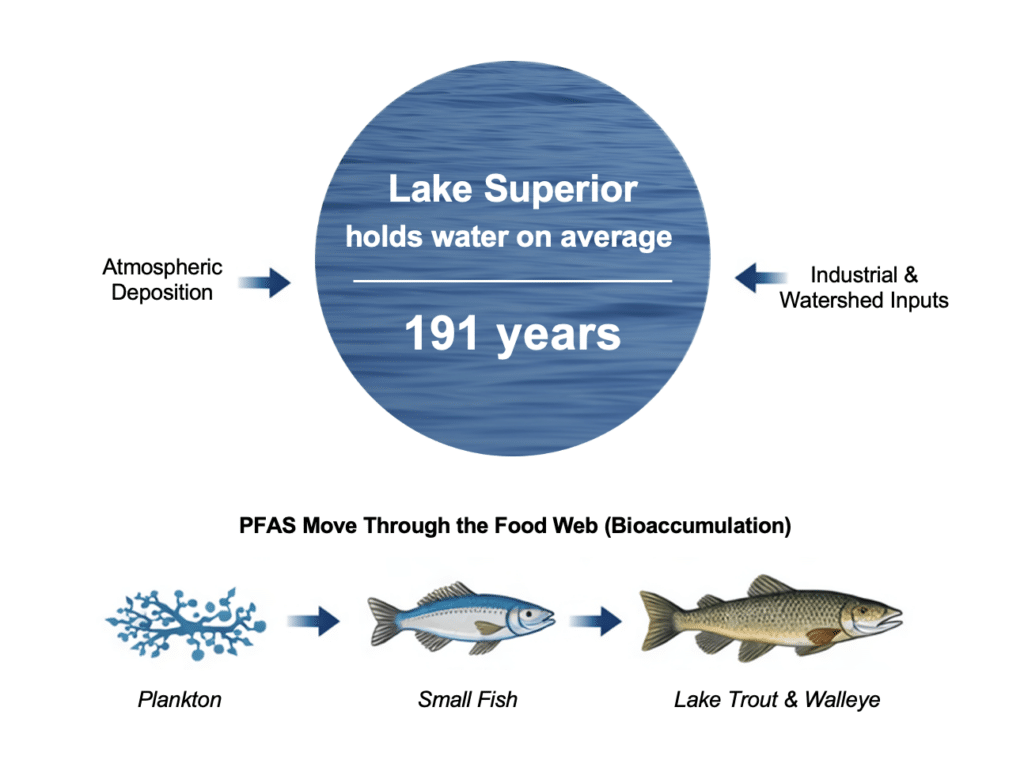
How PFAS enter Lake Superior
As we reported in 2024, atmospheric deposition is a major pathway delivering these chemicals into the lake. Peer-reviewed research confirms that airborne PFAS — carried on particles and in precipitation — deposit directly into surface waters across the basin.
In relatively remote areas like Lake Superior, where large local industrial sources are limited, the atmosphere is considered a major driver of contamination, though tributaries and wastewater inputs also contribute in parts of the basin.
This aligns with monitoring by the Integrated Atmospheric Deposition Network (IADN), which has tracked toxic chemicals in rain and air around the Great Lakes for decades. For a “headwaters” lake like Superior, atmospheric inputs can outweigh pollutants coming from local tributaries, particularly in less developed regions.
What’s new: a frozen archive reveals progress
A recent study published in the Journal of Great Lakes Research, led by researchers at the U.S. EPA’s Duluth laboratory, analyzed nearly 1,000 archived fish samples — including lake trout and walleye — collected from all five Great Lakes over several decades. By testing frozen samples originally collected for other contaminants such as mercury, scientists were able to reconstruct long-term PFAS trends in fish tissue.
The findings show a notable shift:
The Rise: Concentrations in fish increased through the late 20th century, peaking in the 2000s before leveling off or beginning to decline in many locations.
The Decline: Levels began decreasing after the early-2000s phase-out of “legacy” compounds such as PFOS by major manufacturers.
The Takeaway: The data suggest the lakes are responding to reductions in production and emissions of legacy PFAS. As lead author Sarah Balgooyen, a former EPA Duluth researcher, told MPR, “We know these fish are safer to eat than they were even 10 years ago.”
A Superior paradox
Lake Superior has an average water residence time of about 191 years — meaning it takes nearly two centuries for the lake’s water to fully flush. Yet fish tissue concentrations appear to be declining much faster than the lake’s water turnover would suggest.
This indicates that biological systems can respond relatively quickly when emissions of certain legacy PFAS are reduced, particularly when atmospheric inputs decline.
Looking forward: an evolving story
Scientists attribute much of the decline to the transition away from legacy compounds such as PFOS and PFOA. However, while these specific chemicals are decreasing, shorter-chain replacement PFAS are now the focus of ongoing monitoring.
Short-chain PFAS generally bioaccumulate less in fish than PFOS, but they are highly mobile in water and remain persistent in the environment. Their long-term ecological and human health impacts are still being studied.
As study co-author Gary Ankley told MPR, “We don’t know exactly what levels are safe…It’s encouraging that they have decreased over time. But it’s very much an open-ended story at this point, and in terms of saying whether the levels that are out there now are going to be problematic in terms of human health or ecological effects, we’re still not entirely certain about that.”
Researchers aren’t yet certain if levels will continue to drop or eventually plateau, meaning continued vigilance and monitoring remain essential for for understanding long-term risks to both wildlife and people.

Key takeaways
Legacy PFAS chemicals are declining: PFOS — historically the most common PFAS detected in Great Lakes fish — is trending downward in many locations.
Regulatory action appears to matter: The downward trend is closely associated with the early-2000s phase-out of certain legacy PFAS compounds.
Lake Superior shows improvement: Despite its long residence time, fish tissue data indicate measurable response to reduced emissions.
Stay informed: While trends are encouraging, anglers should continue to consult state fish consumption advisories for species-specific guidance, including Minnesota’s MDH “Eat Safe Fish” recommendations.
More Info
- Study: Historical PFAS trends in the Great Lakes using four decades of archived fish – Journal of Great Lakes Research
- Study shows PFAS levels dropping in Great Lakes fish – MPR News
- PFAS levels in Great Lakes fish are declining – Wisconsin Public Radio
- Long-term PFAS Trends in Archived Great Lakes Fish – Environmental Science & Technology
- Minnesota Fishing Guidelines: MDH “Eat Safe Fish” Guides