


The Forest Service has published its latest permit and visitor-use report for the Boundary Waters Canoe Area Wilderness (BWCAW). While visitor numbers remain about the same, cancellations and no-shows continue to rise.
Visitor numbers remain steady
In their latest Boundary Waters (BWCAW) Permit and Visitor Use Report, the Forest Service noted that “over 40% of on-sale reservations were never used” in 2025. When we asked for clarity, they confirmed this figure specifically tracks the permits snatched up on “Go-Live” day in January. It highlights a growing “book now, decide later” culture that leaves popular entry points empty while other paddlers are locked out.
According to the report, visitor numbers have remained relatively steady in the BWCAW since a spike in 2021. In the report, 148,687 people visited last year, slightly fewer than the previous year. This included paddlers, motorized boaters, hikers, and day-use and winter visitors. A total of 41,616 annual permits (quota and self-issued) were reserved. For the past four years, that number hasn’t fluctuated much.
“Go-live” day continues to be popular
A permit is required year-round to visit the BWCAW. From May 1 through September 30, visitors must secure a quota permit. According to the USFS, any visitor taking an overnight trip (paddle, motorized, or hiking) or a motorized day trip must obtain a quota permit (reserved or walk-in). These include a reservation and a fee. However, between October 1 and April 30, visitors can pick up a self-issued permit at an issuing station or the entry-point trailhead kiosk. These don’t require a reservation or fee.
Quota permits become available on the last Wednesday in January at 9 am (CST). Many visitors come ready to make their online reservation, eager to secure the entry point they’ve planned. While many know it as “go-live” day, it’s worth noting that recreation.gov changed the wording a couple of years ago to “on sale”, but old habits die hard.
Along the edges of the wilderness, there are numerous entry points. Each entry point has a limited number of quota permits available each day. The USFS originally put the system in place to manage visitor impact and retain the wilderness character. Last year, visitors reserved a total of 26,461 quota permits.
More permits are picked up from a commercial issuing station, such as an outfitter. In 2025, 24,059 permits were issued from commercial issuing stations, up from 19,430 in 2024. This may be because starting in 2025, the Gunflint Ranger Station in Grand Marais and the Kawishiwi Ranger in Ely stopped issuing BWCAW permits.


Cancellations, no-shows still a problem
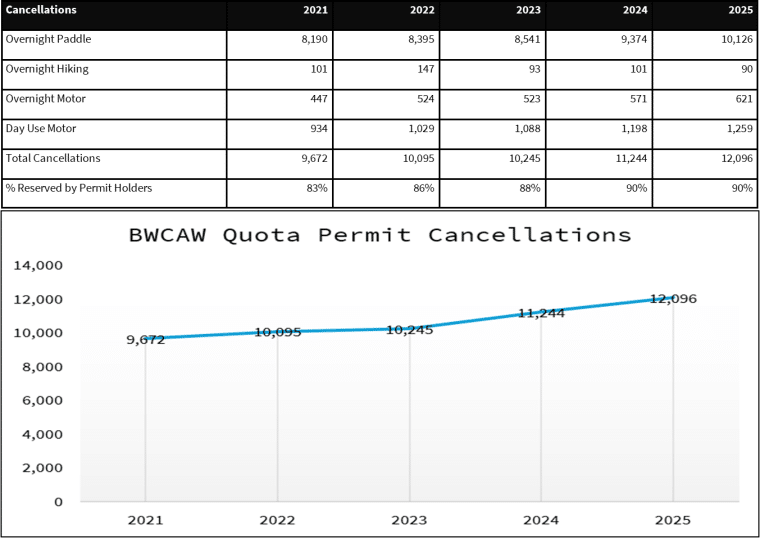
Last-minute cancellations and no-shows are still on the rise. In 2025, a total of 12,096 quota permits were canceled, up from 11,244 in 2024. There were a total of 3,674 no-shows in 2025, up from 3,572 in 2024. Most of the cancellations and no-shows came from overnight paddlers.
The data shows that visitors cancel most quota permits 30 days or less before the entry date. They canceled 3,986 permits 0-4 days before a trip and 4,593 permits 5–30 days before a trip. Additionally, another 3,517 quota permits were canceled more than 30 days in advance.

The Boundary Waters, delivered weekly
Join thousands of readers receiving free wilderness news and weekly updates from the Northwoods.
Winter recreation saw a bump. Visitors pulled a cumulative total of 866 self-issued permits for cross-country skiing, snowshoeing, and dog sledding in 2025, up from 546 in 2024. This includes winter campers who usually travel by ski or snowshoe through the wilderness. Seasonal fluctuations likely affect some visitor use in the off-season.

Who’s visiting canoe country?
The BWCAW is the most visited wilderness in the United States. The majority of visitors are overnight paddlers, with the second-largest use coming from day-use motorboats, though significantly less than overnight paddlers.
In 2025, most visitors to the Boundary Waters were adults. While youth visitors (17 and under) made up the second-largest sector, their numbers have trended downward since 2021. Other visitor calculations include Seniors (62+), adults, and youth with disabilities.
For the past five years, group sizes have not changed much. The average group size is around 4 people for a quota permit and around 3 people for a self-issued permit. Each permit, whether quota or self-issued, allows up to 9 people and 4 watercraft. In addition, everyone under the same permit must camp and stick together. Some campsites can accommodate larger groups, but most work best for smaller groups.


How to avoid cancelling a quota permit
When you reserve a quota permit, review the “Need to Know” and “Fees & Cancellations” sections on the reservation page to understand the requirements. Follow some of the Forest Service recommendations below to reduce the chance you’ll need to cancel your permit. Quota permits require a reservation and fees.
- Only one person in your group needs to reserve a quota permit. However, it’s a good idea to list an alternate permit holder in case the primary permit holder cannot pick up the permit. You can add or remove regular group members later, but you cannot change the permit holder or alternate permit holders after you make the reservation. Note that you cannot add alternates later.
- After you reserve a quota permit, you cannot change the entry date or entry point. If your plans change, you must cancel the permit and make a new reservation (depending on availability). Try to have your plans finalized before reserving a permit. It might be helpful to have a few entry point options in case the one you’d like is taken. Permits are available throughout the season. Be sure that the issuing station you select to pick up your permit from is nearest to the entry point you’ll be starting from.
- The Forest Service may cancel duplicate or overlapping reservations under the same permit holder name without notice. This policy helps prevent permit hoarding.
- Cancel your permit as soon as possible if plans change. Early cancellations give others a chance to reserve permits, while last-minute cancellations are harder for others to use.
Clare Shirley from Sawbill Outfitters shared her perspective on why cancellations continue to increase, including “perceived scarcity”. She said, “When visitorship rose during Covid, and then quotas were lowered post-Covid, it generated a notion that permits were scarce and one had to reserve one on go-live day in January lest they miss out completely.”
She added, “Some people are reserving prospective permits on opening day and deciding later which one they will actually use. Sometimes they cancel the permits they no longer need, and sometimes they forget, creating no-shows.” She also noted that outfitters use the same system as everyone else when reserving a permit, and that the USFS closely monitors it.
The Superior National Forest publishes its permit and visitor use report each spring, showing data over a five-year period.

More info:
- Permit and Visitor Use Report – USFS-Superior National Forest
- Boundary Waters Canoe Area Wilderness – USFS-Superior National Forest
- Boundary Waters Canoe Area Wilderness Trip Planning Guide