
A long-term songbird study is underway deep within Quetico Provincial Park, one of Canada’s premier wilderness areas. This spring, researchers placed 17 recording units across key habitats to monitor songbird species. Retired park biologist Brian Jackson recently explained how this data reveals trends over time, especially as climate change affects the park.
Remote devices record birdsong
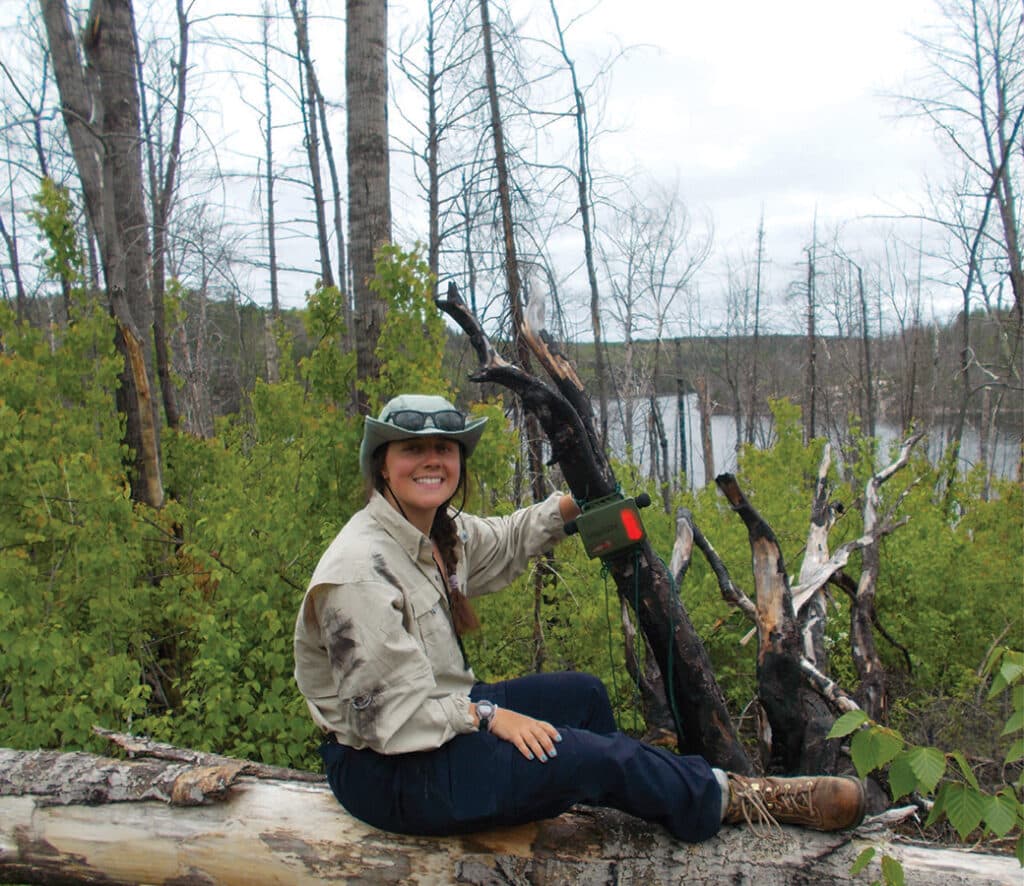
Birdsong fills the air as a small group of seasonal staff paddles their canoes in Quetico Provincial Park (Quetico). The crews stash their canoes and head into the woods thick with aspen, pine, and birch. They select a tree and attach a dark green box to it, a songbird meter, also known as an Autonomous Recording Unit (ARU). Their work will include placing a unit at 17 locations throughout the park. For the next month or so, it will record birdsong to help identify species.
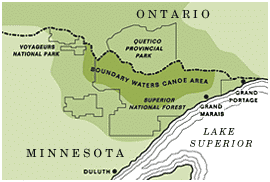
Quetico, located in Canada, shares its southern border with the Boundary Waters Canoe Area Wilderness. It mostly attracts canoe paddlers seeking to explore its over 1.1 million acres (460,000 ha) of water-filled landscape. Only about 20,000 people visit the remote area each year, far fewer than the number who visit its wilderness neighbor to the south.
Wildlife abounds in the park, including moose, black bear, wolves, and eagles. The mix of hardwood and coniferous forests, dotted with wetlands, attracts numerous songbirds and waterfowl. Researchers have documented over 200 bird species in Quetico. Most of those are migratory, arriving mid-May through early June each year to breed and raise their young.


Managing ecological integrity
Brian Jackson, who was the park biologist from 2014 to 2024 and is now the science chair for the Quetico Foundation, shared with us why the birdsong study is important.
In 2006, Ontario established directives for managing provincial parks with a goal of maintaining ecological integrity. Brian told us that “basically, whatever would have been there before, things like the composition of the forest, the natural processes of trees and vegetation and wildlife — we try to maintain that.”
Prior to 2014, no one had studied birdsong in Quetico. In 2013, a park biologist began organizing the project and Jackson put it into motion. Since then, and up until 2019, researchers have headed out into the woods, tracking songbirds to see whether areas are losing or gaining species and why. They’re also trying to understand how climate change may affect the forest and the species that depend on it. As Jackson noted, “What’s going to happen as we go through climate change?” He added that based on predictions, Quetico is one of the places that could change dramatically. The data collected contributes knowledge to the overall health and functionality of the park’s ecosystem.

Three ecosites surveyed
To gain a clearer picture of songbird species in the park, researchers identified three ecosites. This includes the Aspen-Birch hardwood forest, which is known as the upland area. It makes up about 24% of the park. Another is the Conifer-Swamp-wetland areas that constitute about 7% of the park. The final is the Red Pine-White Pine conifer area, with historically large forest stands. Added as an ecosite in 2016, it covers about 20% of the park. Each area of study or plot ranges from a few to tens of hectares.
Summer crews place a songbird meter, a dark green box with a battery-powered recording device, in each plot. This is usually in the same plot and on the same tree from season to season. They set the meters to record for two- to five-day periods. Recording occurs over four to five weeks, beginning about half an hour before sunrise and lasting about 10 minutes.
Later in the season, the recording monitor is picked up by park crews. The recordings are stored on an SD card. During the winter, a consultant with bird-song expertise downloads and listens to the recordings, logging data including the type of bird, the ecosite or sites where it was heard, and how many were heard. A busy site may have up to a dozen birds.

The Boundary Waters, delivered weekly
Join thousands of readers receiving free wilderness news and weekly updates from the Northwoods.
Five years of monitoring
The initial survey spanned 5 years. During that time, 70 songbird species were identified. Additionally, 10 other wildlife species were noted, including waterfowl and amphibians. The average number and type of species heard over the 5-year study remained relatively the same. Jackson said that because changes happen slowly over time, it wasn’t a surprise that the numbers were steady.
The most common songbirds in the Aspen-Birch hardwood ecosites were the Nashville Warbler and Red-eyed Vireo. In the Conifer-Swamp and Red and White Pine ecosites, the Nashville Warbler, Myrtle (Yellow-rumped) Warbler, Ruby-crowned Kinglet, White-throated Sparrow, and Golden-crowned Kinglet were all heard over 90% of the time. All of these birds migrate from their northern breeding grounds to winter in the southern U.S., Mexico, and Central or South America. Less well-known species of concern, such as the Canada Warbler and Olive-sided Flycatcher, were also noted.
Jackson said that what will be most revealing is what these numbers show over the coming decades. He commented that it’s too early to identify songbird trends yet. The most common species will be monitored closely as they are easiest to track. He said, “If we start seeing changes, then do we start looking at something happening here? Or is the change related to something happening where they are wintering? If they’re declining, is it all for the same reason?” Changes in insect availability and the tree canopy could impact species.


Program resumed last year
The program paused after 2019 but resumed last year. This was because other projects also needed attention, such as the development of a comprehensive breeding bird atlas.
Jackson said that the hope is that this study will continue for at least the next five years. If researchers are seeing changes, it will likely be longer. As data accumulates, it will help identify and analyze trends across years of songbird monitoring. While there isn’t yet enough information to determine significant species losses or gains, the work will benefit the broader study as Quetico responds to temperature and possible habitat changes in the coming decades.
Funding for the birdsong study and research staff comes from the Quetico Foundation. Founded in 1954, the non-profit works to preserve the park’s natural and cultural legacy. This is done primarily through raising awareness, conducting research, and providing education about the park.

More info:
- Long-Term Monitoring of Forest Birds in Quetico Provincial Park – 2014 – 2019 Data Summary – Quetico Foundation
- Quetico Provincial Park