
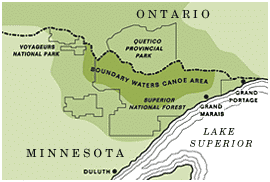
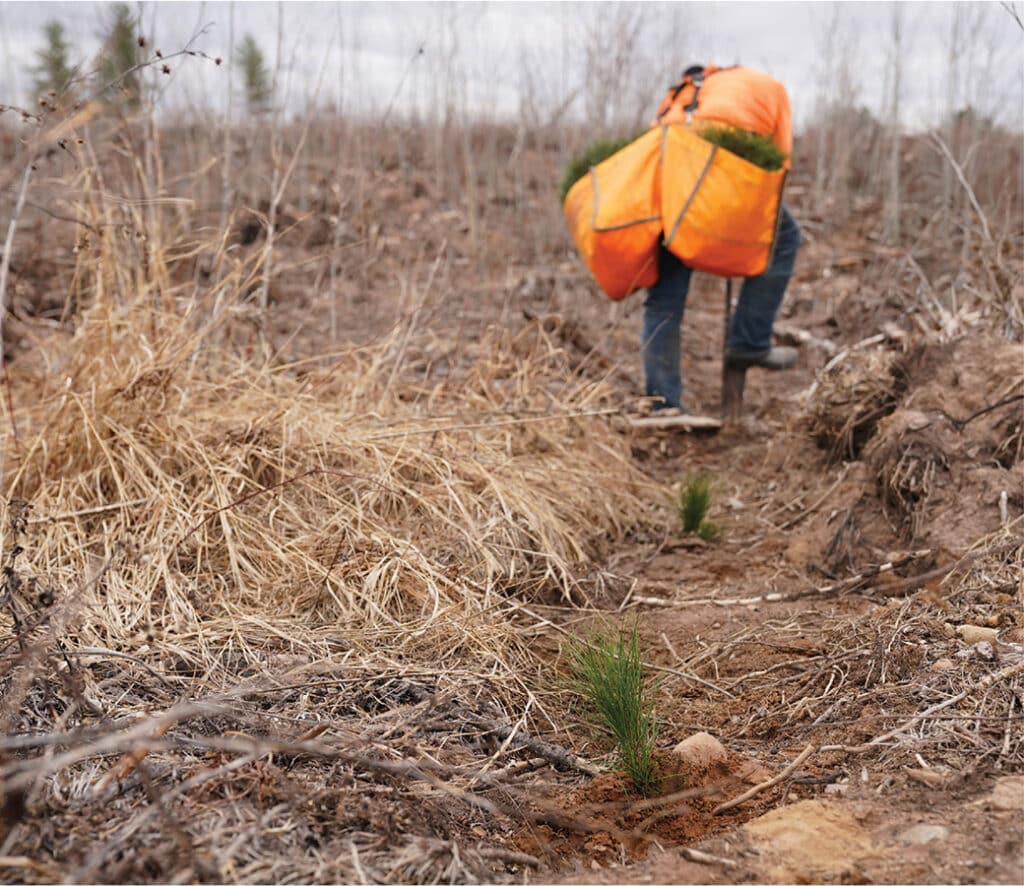
In an effort to restore state land affected by wildfires or windstorms, crews with the Minnesota Department of Natural Resources will plant almost 2 million tree seedlings throughout parts of state-owned land this spring. This will include 2,673 acres in the northeastern part of the state.
Mixed species help forest thrive
Crews with the Minnesota Department of Natural Resources (MN DNR) are heading into the field to plant 2 million tree seedlings on state-owned land across the state. To better understand the effort in Northeastern Minnesota, we reached out to the DNR. They expect crews to plant 630,000 seedlings on about 2,673 acres, a little over half of which will be seeded by air. The mixed forest in Northeastern Minnesota includes both boreal (coniferous) and broadleaf (deciduous) stands. Lakes and peatlands also dot the rugged, glacially-shaped landscape.
According to foresters, this work will involve a diverse range of species. This includes red, white, and jack pine, white cedar, yellow birch, northern red oak, and bur oak. They mentioned that they use dual methods to plant trees “Some sites are easy to access and seedlings are hand-planted by crews of contractors who can each plant thousands of seedlings a day. Other sites are remote and challenging to reach, and seeds are dispersed by helicopter – this year 1,673 acres will be aerially seeded with jack pine, black spruce, tamarack and white pine.” The variety benefits the forest’s future health by minimizing the spread of invasive species and disease. In turn, a healthy forest benefits the ecosystem, improves air quality, and supports clean water.
The agency’s Silviculture Program is spearheading the efforts. Silviculture is the science and art used to help establish, steward, and monitor the health, growth, and biodiversity of a forest.
While the state was unable to provide us with a map, they said that planting sites include state forests such as Grand Portage, Pat Bayle, Finland, Bear Island, Sturgeon River, George Washington, Kabetogama, Koochiching, Pine Island, Big Fork, Bowstring, Hill River, Wealthwood, and Solana.


Trees will be monitored
Once seedlings are planted, foresters will monitor them for a while. They will conduct what they call ‘regeneration surveys’ over the next 10 years. Their work includes ensuring that plenty of healthy trees are growing per acre. This includes monitoring for signs of disease and invasive species. In addition, observations will help them determine whether they need to make any future interventions. Some of the interventions could include a “combination of mechanical and chemical treatments, such as brush sawing or herbicide use where appropriate.”
To improve the chances of success for young trees, crews use bud capping. They accomplish this by stapling a small square of mesh over the tree’s top (terminal) bud. This prevents animals like white-tailed deer from browsing and stunting their growth.
Work will take place over the next month. Meanwhile, funding for this initiative is provided through the state’s general fund and bonding dollars. People are also welcome to support future tree planting projects. You can find more information online at the Minnesota’s Future Forest Fund.


More info:
- News release: Minnesota DNR to plant nearly 2 million tree seedlings on state land this spring
- Global environmental organization plants 2.3 million trees in northern Minnesota
- Researchers restore forests in northeastern Minnesota’s changing landscape