


It’s that time of year again—when everybody keeps asking, “Are the smelt running yet?” The current answer in Duluth is a resounding “they’re comin’ in!” This year the first three days of May featured a full moon followed by warmer temps—all enticing the long-awaited smelt to the sandy shores of Park Point, where family teams of netters corral the fish in seine nets. Big crowds worked the smelt influx up and down the beach over the weekend, with varying success. We were right there too, with my daughters and family friends, plying the dark waters of the night. Here’s how smelt netting works, and why it’s a short-term craze every spring on Lake Superior’s shores.
Smelt are a non-native fish that was accidentally introduced to Lake Superior by humans. Smelt are a shiny silver fish with a faint purple stripe down their sides. They’re also tasty little morsels, and many people think they don’t have a “fishy” flavor or smell. In fact, to some they smell like cucumbers! Smelt make their annual nighttime spawning runs up the mouths of rivers when water temps start to reach 42°F.
To net smelt, fisherfolk use either a seine net (pulled by two people), or a dip net (single-person net). Seine netting is popular on sandy beaches where smelt cruise along close to shore on spawning nights. Dip netting is done exclusively in river mouths—ambushing the smelt as they start their swim upstream.
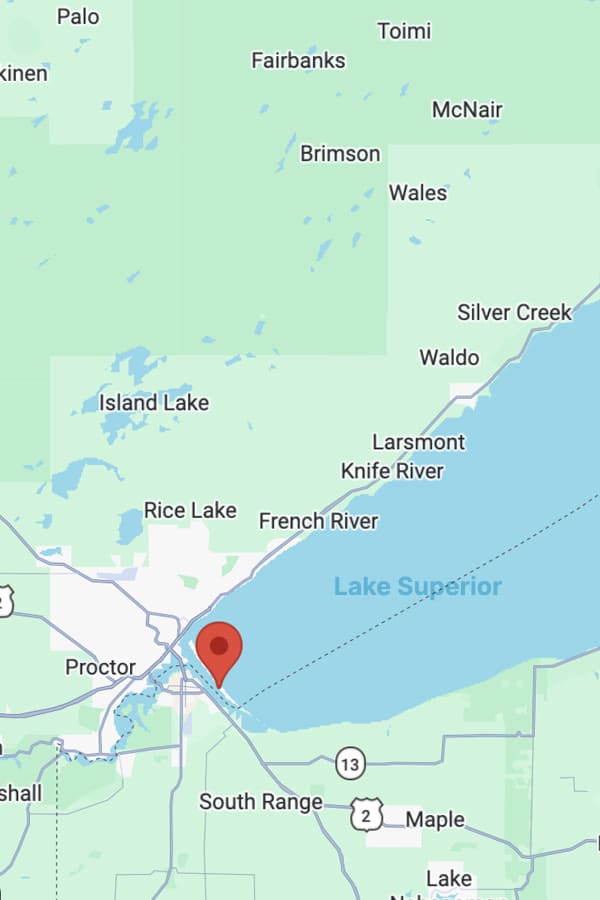
A night on Park Point
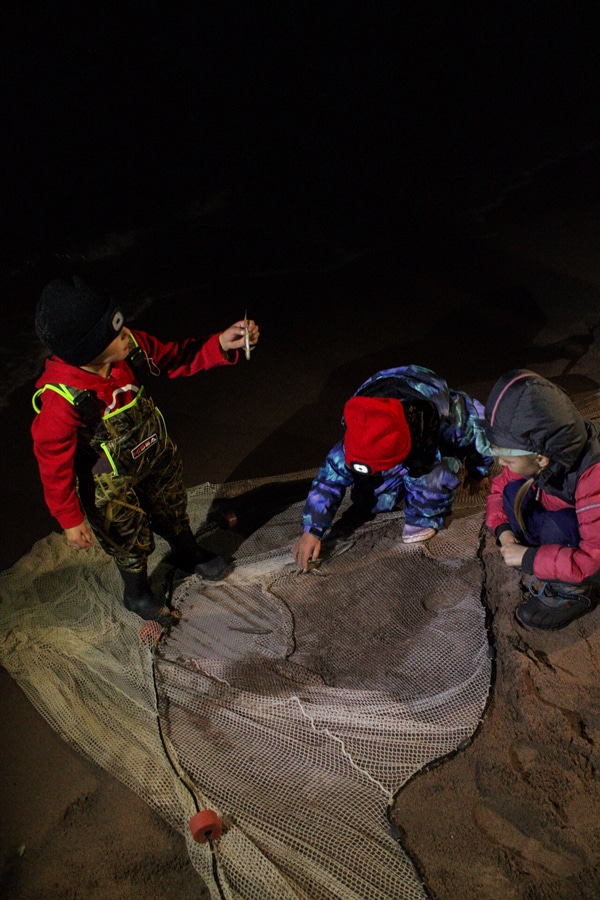
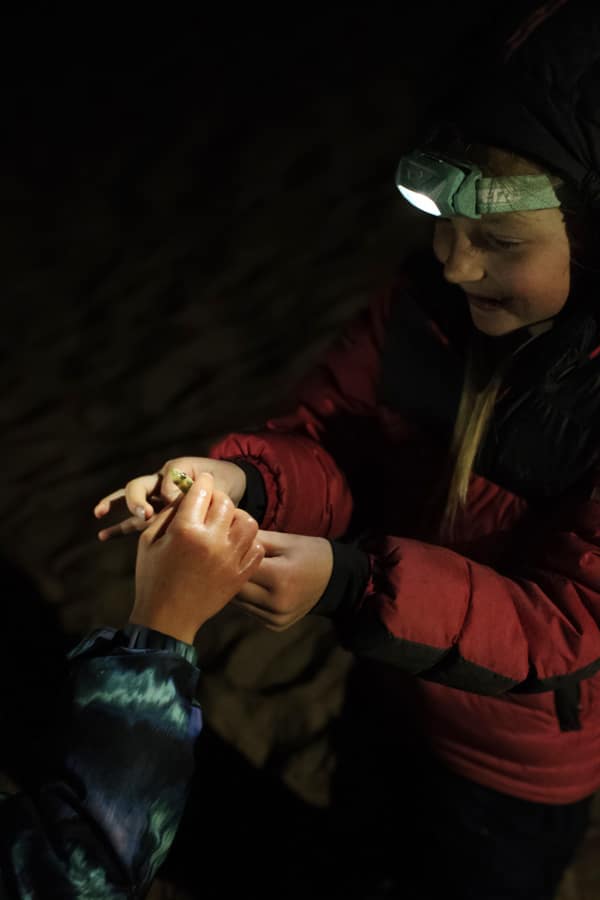
Hopes were high as our family met up with friends at the Park Point Beach House at 9:00 p.m. The beach was humming with activity. Headlamps flickered in the dark, nets whispered in the water, and the resultant smelt catch went plopping into buckets up and down the seven-mile stretch of sandspit.
Our family has been smelting together for the last ten years. My three daughters are team players. High-schooler Vanessa goes chest-deep into the lake to pull the net with me. Middle schooler Adriana takes photo evidence of our results. And six-year-old Stella counts our catch once we pull the net on shore.
How smelt netting works
Vanessa and I slithered into our waders, squeezed into a spot on the packed beach that could accommodate our 25-foot wide net, and trudged into icy Lake Superior. We were with two other families, and rotate “pullers” through our team of friends. Seine netting is best done in big groups—water resistance creates heavy drag on the net, leading to sore shoulders and achy backs. Take turns pulling for maximum results.
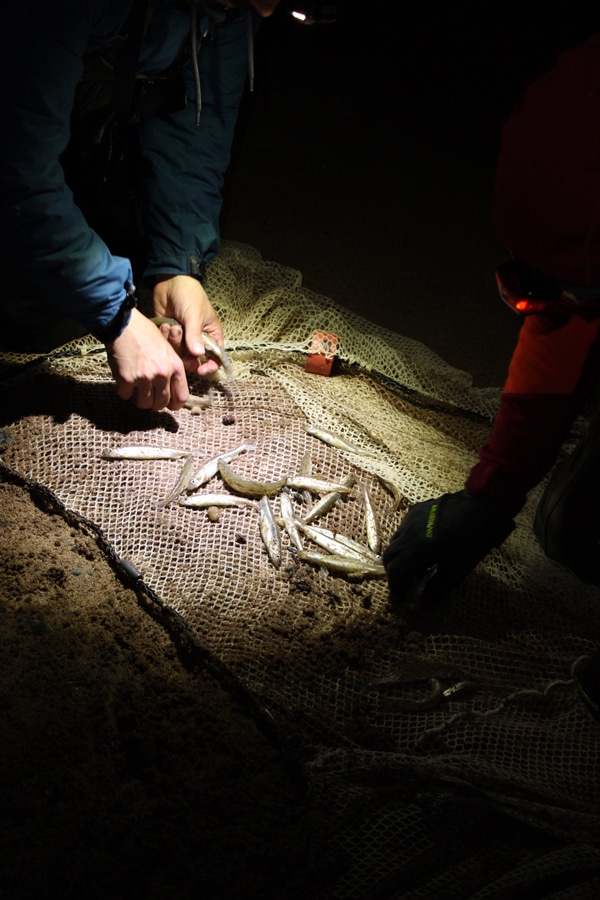
So how does a seine net work? The knotless nylon is meshed tight enough that the wily smelt can’t swim through. The net is held together by a top rope that floats on the surface, and a sinking bottom rope that pulls the net down to the lake bottom. Seines may not be more than 25 feet long or 4 feet deep in Minnesota.
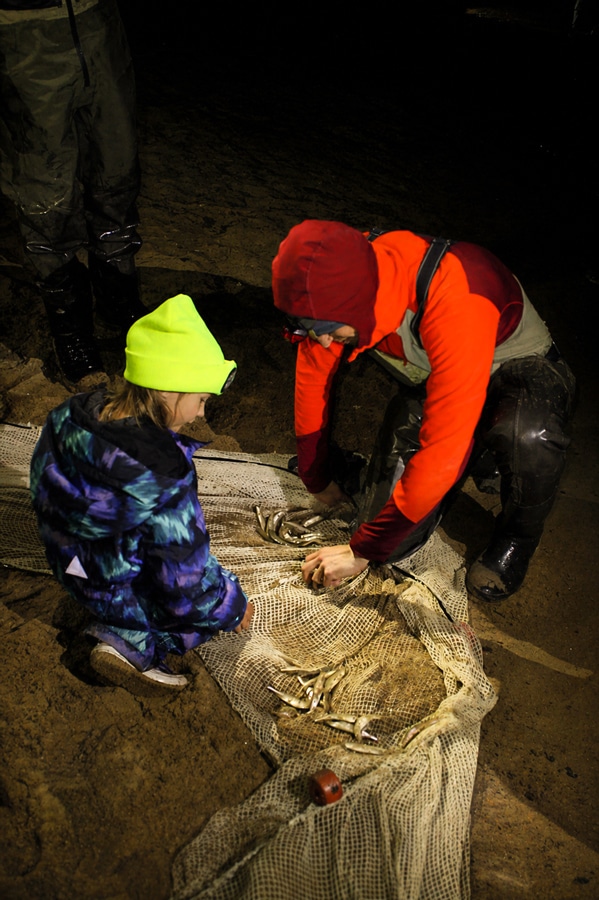
Seining is old school, low-tech fishing. An effective pull traps smelt in the net until you can haul them up on shore. The moment when you get the net on the beach and inspect your catch, your heart skips a beat—seeing the net alive with fish can be a stunning experience.
An invasive fish becomes a tradition
Smelting in Duluth is a community event. There’s a rich tradition of smelting here, going back 70 years. Smelt were first discovered on Lake Superior in 1946. By the time this non-native species arrived in the lake, sea lamprey—another invasive species—were reducing the number of native lake trout. With far fewer lake trout to eat the smelt, there was a rapid increase in smelt numbers. Their population exploded, and got out of balance. The peak of Duluth smelting was in the 1960s and 70s, when people would take home garbage cans full.
Over the last 30 years, lake trout have recovered thanks to sea lamprey control and harvest restrictions for trout. There’s much greater predation on smelt today from trout and salmon, reducing smelt abundance.
Still, some of the carnival-like atmosphere of the past persists on Park Point, and at the Lester River in Duluth. A big part of the thrill is that these fish are only close enough to shore to be caught for a couple weeks each year, making the timing piece critical. When they’re on, it’s time for sleepless nights spent swinging nets.
These days, social media groups share information and keep each other up to date on what’s happening with the run. It’s important to tap into firsthand reports: these fish may have tiny brains, but still enough savvy to outsmart their human predators. Unlike many other fisherfolk, those who pursue smelt are happy to share their intel on spots and times that are working. According to Minnesota DNR regulations, there’s no limit to how many smelt can be kept, and it is allowed to sell the smelt you catch in Minnesota. They are considered an invasive species, after all.
Waiting for the peak run
On our first night out—May 2nd—we brought home about a gallon of smelt. Stella and her first-grade friends counted about 200 fish. That was a good warm-up for Sunday, when we were getting upwards of 50 smelt per pull to start out. These manic moments are etched in the minds of kids and adults alike. But the smelt tend to run in pulses, and within an hour our pulls were bringing in only 10 on average. Still, with our friends we filled a five-gallon bucket full, to be divided between three families.
One thing is clear—the best fishing is still to come over the next 10 days or so. In fact, the last three days have turned cold, and the smelt have largely taken a pause in their spawning ways, as they wait for warmer water. The peak of the run will likely be this coming weekend. Smelt are in many ways Lake Superior’s most sought-after fish. Sure, the ”big lake” holds beautiful game fish like lake trout, whitefish, and salmon. Still, no other species in Superior has the same magnetic draw as smelt. These little fish, not much longer than your finger, are more than a fish—they’re a cultural experience.