


In a narrow 50-49 vote, the Senate voted to pass House Joint Resolution 140 (H.J. Res. 140), which would reverse the 20-year mining ban that established protections for 225,504 acres in the Superior National Forest. The proposal clears the way for developers to build a copper mining complex just outside the Boundary Waters Canoe Area Wilderness.
Vote passes by a narrow margin
After weeks of waiting, the Senate passed a bill Thursday morning to lift a 20-year mining withdrawal on hundreds of thousands of acres in the Superior National Forest. Republican Rep. Pete Stauber introduced the controversial bill on January 12. Stauber initially introduced the bill, called H.J. Res. 140, a Congressional Review Act (CRA), to the House. The House voted in favor of it in late January, then sent it to the Senate for a vote. The Senate passed the bill narrowly by a margin of 50-49. Every Democratic senator voted against it, as did two Republican senators, Thom Tillis (North Carolina) and Susan Collins (Maine). Senator Josh Hawley (Missouri) was the only member who did not cast a vote.
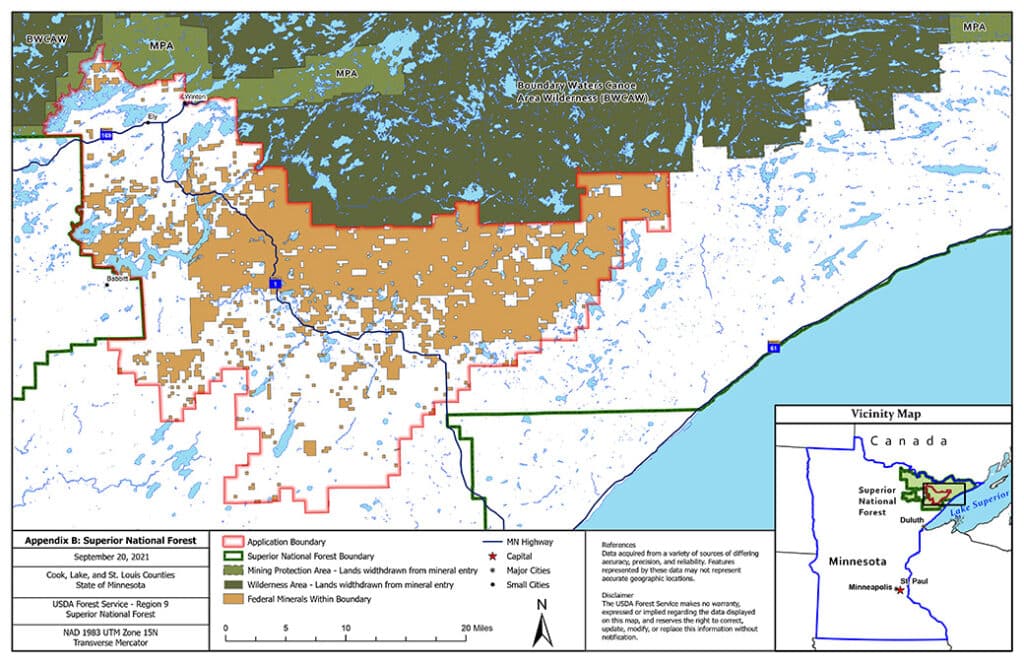
The bill reverses Public Land Order 7917, issued by the Biden administration in 2023. It withdrew 225,504 acres in the Superior National Forest from “mineral and geothermal leasing laws for a 20-year period.” Much of the withdrawal encompassed areas bordering the Boundary Waters Canoe Area Wilderness (BWCAW).
Some have expressed concern about the legitimacy of the CRA. Lawmakers can use it within a limited window (about 60 legislative days) to overturn a federal rule. For months, there has been debate on both sides about whether this ban counts as a rule. Opponents have questioned whether lawmakers can use the CRA almost three years after the 20-year mineral withdrawal was enacted.
A marathon of protest
The vote followed an emotional “night shift” on the Senate floor. Senator Tina Smith (D-Minn) held the floor for nearly five hours on Wednesday night, speaking until midnight to share letters from Minnesotans and tribal leaders.
On Thursday morning, Senator Amy Klobuchar joined the push. While Klobuchar has historically supported iron mining, she was firm in her opposition here, calling the use of the Congressional Review Act to overturn land protections a “dangerous precedent.” Her stance could be a major signal for the project’s future, as the next Governor of Minnesota will oversee the state-level DNR permits required for the mine to ever break ground.
Opening the door for mining
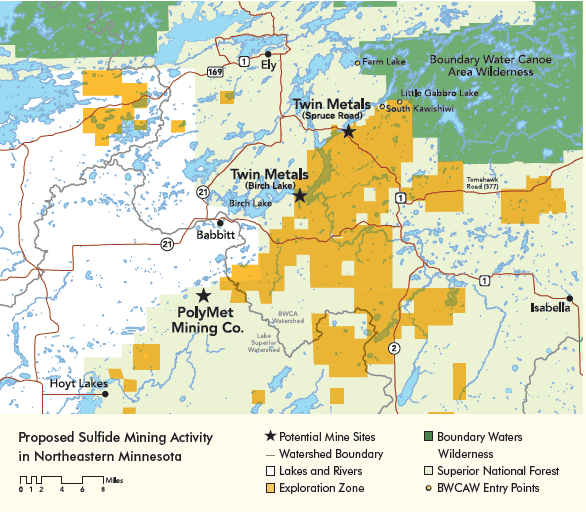
This latest action marks another step toward building a proposed copper-nickel mine just miles from the Boundary Waters Canoe Area Wilderness (BWCAW). Twin Metals, owned by Antofagasta, a Chilean-owned mining company, has been seeking to reinstate two mineral leases near the confluence of the South Kawishiwi River and Birch Lake.
Julie Lucas, the executive director of the copper-nickel industry group Mining Minnesota, told the Star Tribune, “This vote does not open a mine. It opens the door for a transparent, science-based review.” She went on to add, “Mining and environmental protections can co-exist, and our industry is committed to making sure that happens.” Twin Metals anticipates extracting 20,000 tons of copper, nickel, cobalt, and platinum ore per day. The 1,150-acre complex would employ 700 people and operate for 25 years.

The Boundary Waters, delivered weekly
Join thousands of readers receiving free wilderness news and weekly updates from the Northwoods.
Opponents speak out
Conservation groups and other public lands advocates are strongly against the bill and have been speaking out against it for weeks. They argue that pollutants and heavy metals released into Birch Lake would affect interconnected lakes and streams that flow north from Birch Lake into the BWCAW and beyond.
In a press release, Ingrid Lyons, executive director for Save The Boundary Waters, stated that, “Today is a dark day for America’s most beloved Wilderness area, the Boundary Waters Canoe Area Wilderness, and a stark warning call for public lands nationwide. Minnesotans and the American public writ large have been loud and clear — this iconic place needs to be protected. Today, by the very people who claim to represent them, they were ignored, and even worse, silenced. But of course, it’s not over, and we will always keep fighting.”

U.S. Senator Tina Smith, who has opposed the bill, has been vocal for weeks as well. During the debate in the Senate on Wednesday night, she said, “If you support this, colleagues, you are ignoring what Minnesota wants. You’re going to come down on the side of a Chilean billionaire and send it to China? If we’re lucky, that copper will be sold back to us at a profit. That is not an ‘America First’ strategy.”
In 2018, Harvard economists conducted a study on the proposed mine’s potential impacts. They concluded that while there would be some initial economic benefits, the long-term gains of mining would eventually be outweighed by the negative impact on the region’s established recreational industry.
Opponents say this move will not only affect the BWCAW but also set a precedent for other public lands, since the Congressional Review Act allows Congress to overturn new federal rules with a simple majority vote, bypassing the Senate filibuster. In addition, once lawmakers repeal a rule under the CRA, the agency generally cannot issue a similar rule in the future.
What happens next?
The bill now heads to President Trump’s desk, who is expected to sign it. If Trump signs it, it removes a major federal barrier for Twin Metals to pursue permitting and regulatory approvals for its proposed mine on Birch Lake.
Down the road, the state of Minnesota has the option to block the leases. Something that opponents strongly hope the state does as they seek permanent protection for the wilderness. A mine cannot proceed without state approval and permits. The Minnesota Department of Natural Resources (DNR) issues mining permits, reviews environmental impacts, and is responsible for ensuring companies operate mining sites responsibly during extraction and restore them properly afterward.
More info:
- U.S. Senate votes to end mine ban near Boundary Waters; signature from Trump expected – The Minnesota Star Tribune
- U.S. Forest Service (USFS) Environmental Assessment (EA) on Proposed 20-year Mineral Leasing Withdrawal in Superior National Forest – Harvard University Department of Economics
- New effort to open mining near BWCAW could undermine protections outside Minnesota – The Minnesota Star Tribune
- It’s a Dark Day for the Boundary Waters and the Future of Public Lands. Here’s How We Got Here – Outdoor Life
- State minerals leases – Minnesota Department of Natural Resources
- Mineland Reclamation – Minnesota Department of Natural Resources