


Crews recently planted 800 dwarf bilberry plants at multiple sites in the Superior National Forest. This small, low-growing shrub produces berries that resemble blueberries. This important woodland species supports the largest population of northern blue butterflies south of Canada in the Great Lakes region, whose caterpillars rely solely on its leaves to survive.
Expanding bilberry habitat
Recently, the USFS-Superior National Forest (USFS) staff planted 800 dwarf bilberry plugs throughout the Forest. As part of this work, staff collected Dwarf Bilberry seeds (Vaccinium cespitosum) from several healthy plots and sent them to Toumey Nursery in the Ottawa National Forest for propagation. Once the seedlings are large enough to transplant, the nursery sends the plugs back to the Forest, where staff plant them. This year, staff planted the plugs in three separate plots.
According to a social media post by the USFS, “…by taking seeds collected from different sites and planting them at other sites, genetic diversity is increased so populations can become more resilient to environmental change.”
This low-growing, dense shrub produces berries that look like blueberries, but smaller. Growing anywhere from 2-20 inches tall, it spreads by underground rhizomes. As the plant spreads, small, oval leaves fill the forest floor. In spring, tiny white or pinkish flowers delicately line the stems. In spring, the bell-shaped flowers appear, developing into small, dark-blue berries by mid-summer, with a tangy flavor, offering a sharper contrast to the milder flavor of larger, wild blueberries.
Forest crews plant new plugs at sites to support existing populations or to increase habitat for wildlife.
Plant benefits northern blue butterfly

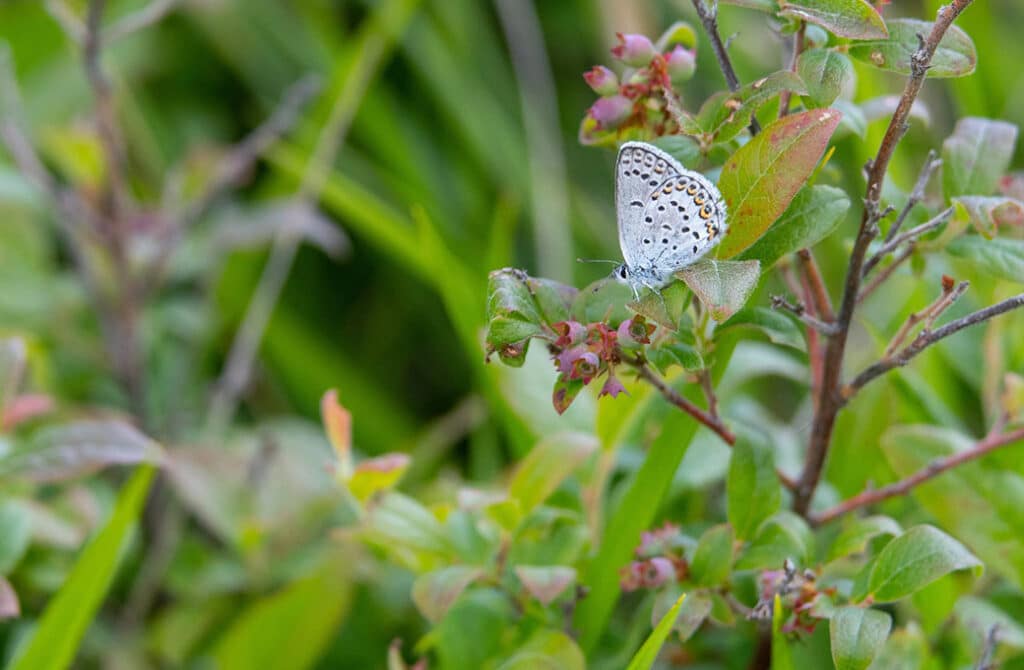
One species that relies solely on this plant is the northern blue butterfly (Lycaeides idas nabokovi). It’s also known as Nabokov’s blue. This subspecies is limited to the northern part of the state, as well as northern Wisconsin, Michigan, and parts of Canada. According to the Minnesota Department of Natural Resources (DNR), the species is “uncommon to rare and highly local.”
According to the Forest Service, this butterfly’s caterpillars feed exclusively on this plant. “The Superior NF [National Forest] has the largest known population of northern blue butterflies that occur in the Great Lakes region south of the Canadian border,” they said.
It’s a great example of how important a single plant species can be to a butterfly’s survival. Throughout the season, the Forest Service maintains and monitors these plants through prescribed burns and seasonal plantings.


More info:
- USFS-Superior National Forest Facebook
- Vaccinium cespitosum, dwarf bilberry – USFS
- Nabokov’s Blue – Minnesota Department of Natural Resources