
Online buzz has begun about when the ice will be gone on Boundary Waters lakes. Using scientific and historical data, the Minnesota Sea Grant has updated its online thaw tracker to estimate when ice will disappear from Minnesota lakes. They recently held a recorded webinar to help users understand this data and the science behind how forecasts are made.
More access to ice data
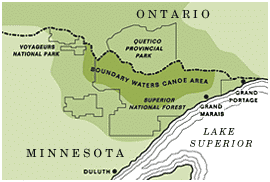
By April, online forums and social media posts are buzzing about when the lakes in the Boundary Waters Canoe Area Wilderness (BWCAW) will lose ice. People eagerly anticipate the soft-water season, planning canoe trips and dreaming of camping and fishing. While the lakes are still firmly locked in ice, the weather is changing. It won’t be long before the lakes are open just in time for paddling season to begin.
To help people predict when their favorite lake might open, the Minnesota Sea Grant has updated its Minnesota Lakes Thaw Tracker and made multiple improvements. They recently hosted a webinar discussing how they use scientific and historical data to predict and estimate ice-out dates.
Estimates have become a challenge
Guessing when the ice will disappear has become more variable. In the webinar, Dr. John Downing, director of the Sea Grant College Program, said that the “thawing of our lakes can vary by something like 9 weeks.” Size is also a factor, as larger lakes take more time to fill than smaller ones. When considering thawing dates, it’s also important to consider lake size, as larger lakes thaw more slowly than smaller ones.
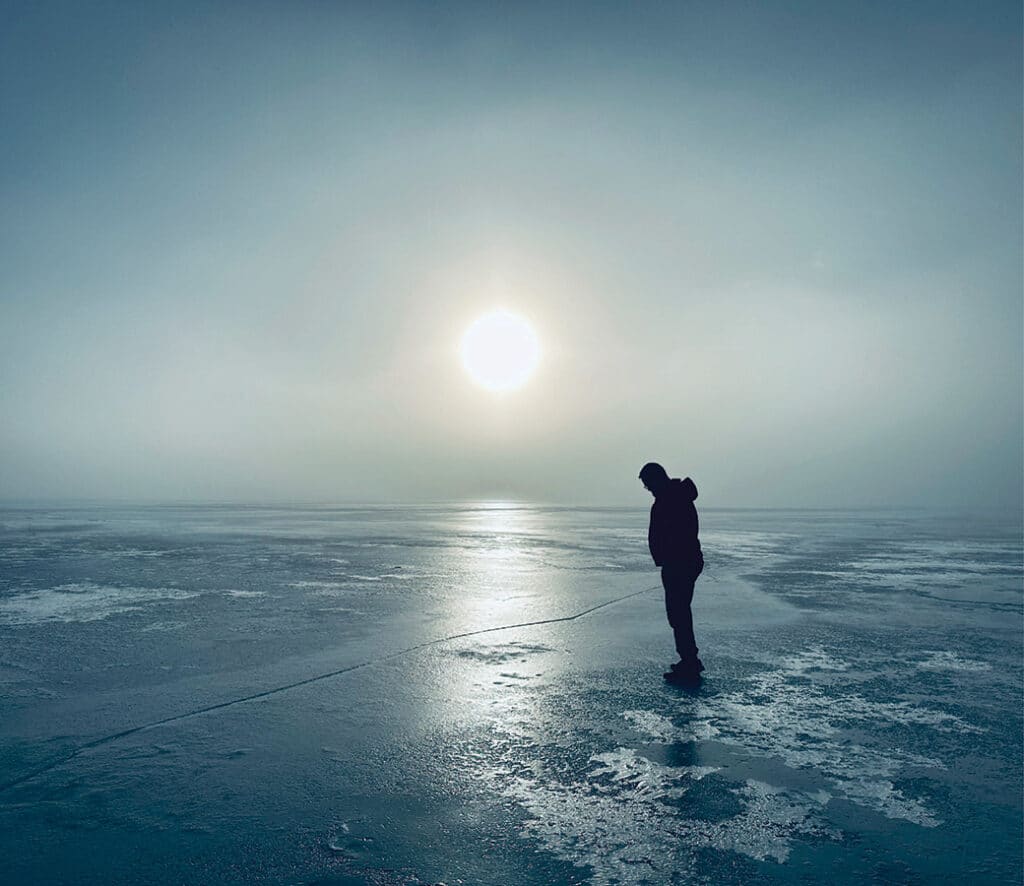
Interestingly, Downing mentioned that lakes thaw not only from the top but also from the bottom. According to the Minnesota Department of Natural Resources (DNR), snow that accumulates throughout the winter protects the ice from sunlight and insulates it from melting. However, summer heat is stored at the bottom of a lake, which is slowly released, keeping the lake a little warmer. In the spring, as the sun’s rays become stronger, the snow begins to melt. The ice becomes exposed, allowing the sun’s heat to pass through and warm the lake, creating a greenhouse effect. As the water warms, the ice not only melts from the top but also from the bottom. Annual spring winds also help to break up the ice.
Downing added that calculating ice-out dates makes a significant difference in when people can start using the lakes to recreate. It also has a trickle-down effect on the tourism industry, which he said relies on “predictable timing” for staffing and trip scheduling.


Track your favorite lake
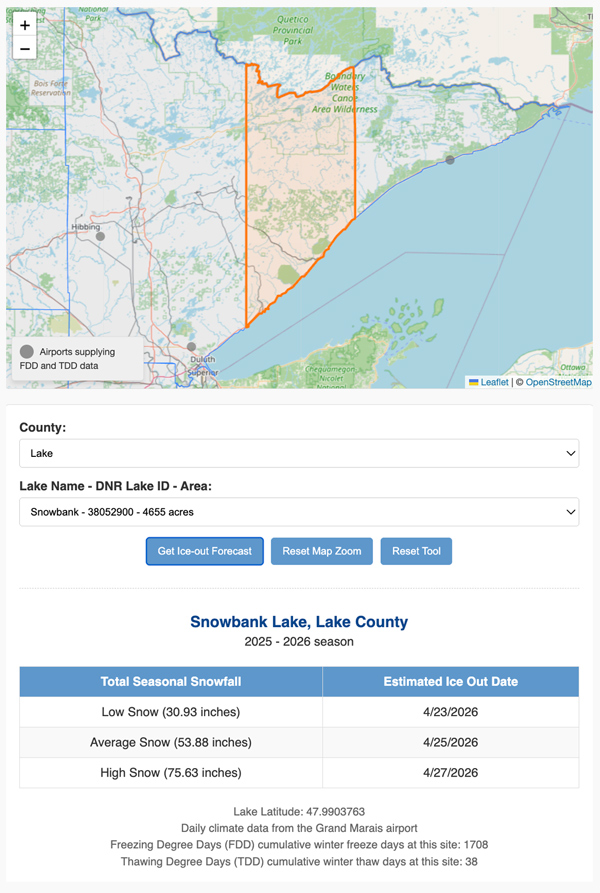
The interactive thaw tracker is user-friendly and is updated daily. By selecting a county and lake, users access snow averages and anticipated ice-out dates for the season. For example, Moose Lake, one of the more popular entry points in the BWCAW, is expected to be ice-free around 4/24. Forecasters estimate when lakes will lose their ice based on multiple factors. This includes historic data from the DNR, the National Weather Service, lake sizes, snowfall amounts, and lake locations.
Information from the tracker becomes available in January each year. Users should be aware that the data does not include ice thickness. Anyone planning to venture out on the ice should always check with the local ranger station or outfitter for current conditions. As always, ice is never 100% safe, and towards the end of the season, it becomes especially unpredictable and rotten.
Early thaw has impacts
According to Downing, early thawing negatively impacts lakes. For example, longer periods of warmer water increase nuisances such as weeds, algae, and invasive species. As deeper waters warm, oxygen levels reduce, and the chemical composition of lakes changes. Consequently, these changes not only reduce water quality but also the fish that require cold, oxygenated water. In addition, an earlier thaw extends the cyanobacteria (blue-green algae) growing season in places like the Boundary Waters, resulting in harmful blooms.
According to a 2025 article published by the Minnesota Pollution Control Agency, ice covers state lakes 17 fewer days each year than it did 50 years ago. Furthermore, the agency states that, “Since 1895, winter low temperatures have increased from around 5 to nearly 8 degrees Fahrenheit, faster than the roughly 3-degree average annual temperature increase. ” This has resulted in over two weeks of less ice coverage, which impacts those who rely on the ice to fish, snowmobile, snowshoe, and ski across lakes. The agency attributes these trends to multiple issues, including greenhouse gases in the air.
While there’s no definitive timeline for when lakes up north will open, researchers are offering valuable insights into seasonal shifts and the science behind thawing. Soon, we’ll be able to dip our paddles in, and spring will be here!

More info:
- Webinar: Minnesota Lakes Thaw Tracker for 2026 – Minnesota Sea Grant
- As winters in Minnesota get warmer, the lake ice season is shrinking – Minnesota Pollution Control Agency
- How Lake Ice Melts – Minnesota Department of Natural Resources