


Moose populations continue to be stable, according to the most recent annual survey by the Minnesota Department of Natural Resources. The state, along with tribal, federal, county, and other partners, plans to implement a new, long-term plan to improve moose habitat across three counties and 50,000 acres.
Population is stable
Throughout this past winter, researchers with the Minnesota Department of Natural Resources (DNR) and their partners conducted aerial surveys of moose in northern Minnesota to assess the population and overall health. The state’s largest mammal once thrived in the cooler climate of mixed conifer and deciduous trees and was more prevalent across the region.
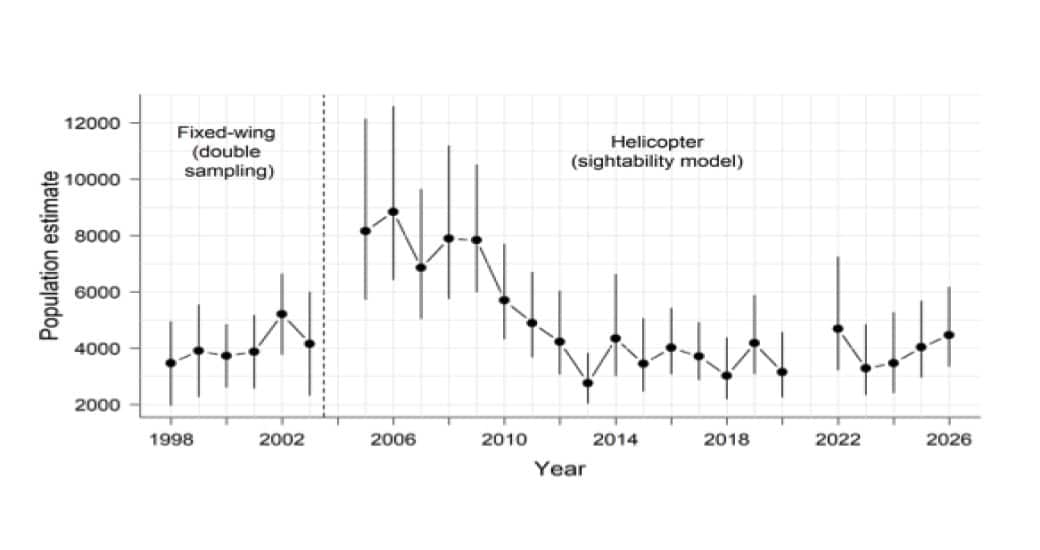
Their numbers dipped dangerously low between 2009 and 2013. Since then, the population has recovered somewhat and continues to hold steady. The latest data estimate the population at about 4,470 animals, up 11% from last year. Although the numbers are promising, wildlife officials remain cautious about declaring a definitive trend. Nancy Hansen, Area Wildlife Manager for the DNR, told us that while the numbers fluctuate from year to year, only time will tell how well the population does. For now, they describe the animals as stable. The agency will continue to monitor the species annually.
Wildlife researchers use helicopters to conduct surveys over randomly selected plots scattered throughout moose habitat. This year, they surveyed 53 plots. As they fly over the woods, they record observations of animals, including their gender. They can also identify calves by behavior and body size.
Animals face risks
Pregnancy rates in females remain strong, but many calves struggle to survive their first year. The DNR attributes this to a few factors: bears target calves when they are not very mobile, and wolves prey on them during their first year. Hansen mentioned that “the actual impacts of bears and wolves on calf survival across all of the moose range are highly variable.” She went on to add that, “predators may not be the biggest problem. For example, it appears that this winter may be shaping up to be a bad winter tick year for moose. So calves that are heavily infested with winter ticks right now may have a tough time surviving to their first birthday.”
Moose face additional challenges and risks to their population and health. Factors such as climate, predators, disease, and food availability can affect their survival. They are no longer hunted in Minnesota, with one exception. The state-managed moose hunting season ended in 2012 and has not been reinstated since. Tribes, however, under the 1854 Treaty Authority, continue to practice limited, subsistence hunting in the fall.

Largest mammal in Minnesota
Moose are the largest members of the deer family and can weigh up to 1,000 pounds. Their long legs help them move easily through marshes and along waterways. Their strength and agility allow them to run up to 35 mph. Remarkably, they are capable swimmers, travelling up to ten miles without pausing. They eat aquatic vegetation found along shorelines, but will also browse on willow and grasses. In winter, they feed mainly on small branches of willow, birch, aspen, and balsam fir. Despite their size, moose are generally not aggressive. However, if a bull is in rut, a cow is protecting her calf, or if they feel cornered, they may charge.
They prefer cooler climates and mixed forests. Before the region became more settled, conifers accounted for 70% of the forests in the northeastern part of the state, and deciduous trees for 30%. Since then, these percentages have flipped. Now, deciduous trees make up 70% of the forest, while conifers account for 30%.
Ongoing habitat work
For many years, agencies and partners in the Moose Habitat Collaborative have worked to improve habitat. The group includes DNR, tribal, federal, and county partners, as well as other conservation organizations. Hansen said their efforts might incorporate “treatments such as prescribed burns, shearing, tree planting, aerial seeding, protection for planted trees, and release from competition of planted trees. She noted that agency biologists review and approve projects before they begin. The funding for this work has come from the MN Outdoor Heritage Fund.
Now, with a grant from the National Fish and Wildlife Foundation’s America the Beautiful Challenge, the group has developed the Moose Habitat Project Implementation Plan. Over the next 5 to 10 years, crews will improve habitat across 50,000 acres in St. Louis, Lake, and Cook counties. The state plans to share details of the new plan in the coming weeks, and the project will benefit not only moose but also other wildlife.
The Fond du Lac Band of Lake Superior Chippewa and the 1854 Treaty Authority partner with the DNR on annual surveys. This winter, they helped fund and provided some of the staff with the 2026 survey.


More info:
- 2026 Aerial Moose Survey – Minnesota DNR
- News release: Minnesota’s moose population remains relatively stable – Minnesota DNR