
Sturgeon, often called living dinosaurs, have existed since prehistoric times. The Great Lakes Aquarium in Duluth partnered with Tribal, state, and federal agencies to help rebuild sustainable populations of sturgeon native to the St. Louis River.
Fish raised at aquarium
State and federal agencies, research facilities, and Tribal officials partnered to release 255 lake sturgeon into the St. Louis River near Duluth. We spoke with Jay Walker, executive director of the Great Lakes Aquarium in Duluth, about the aquarium’s role in this promising restoration effort and the collaboration behind it, including the Minnesota Department of Natural Resources (DNR) and the Fond du Lac Band of Lake Superior Chippewa.
Earlier this spring, the Great Lakes Aquarium raised sturgeon from eggs collected in streams in northern Michigan for the first time. The effort began with a trailer on the aquarium grounds, where jars held incubating sturgeon eggs in St. Louis River water.
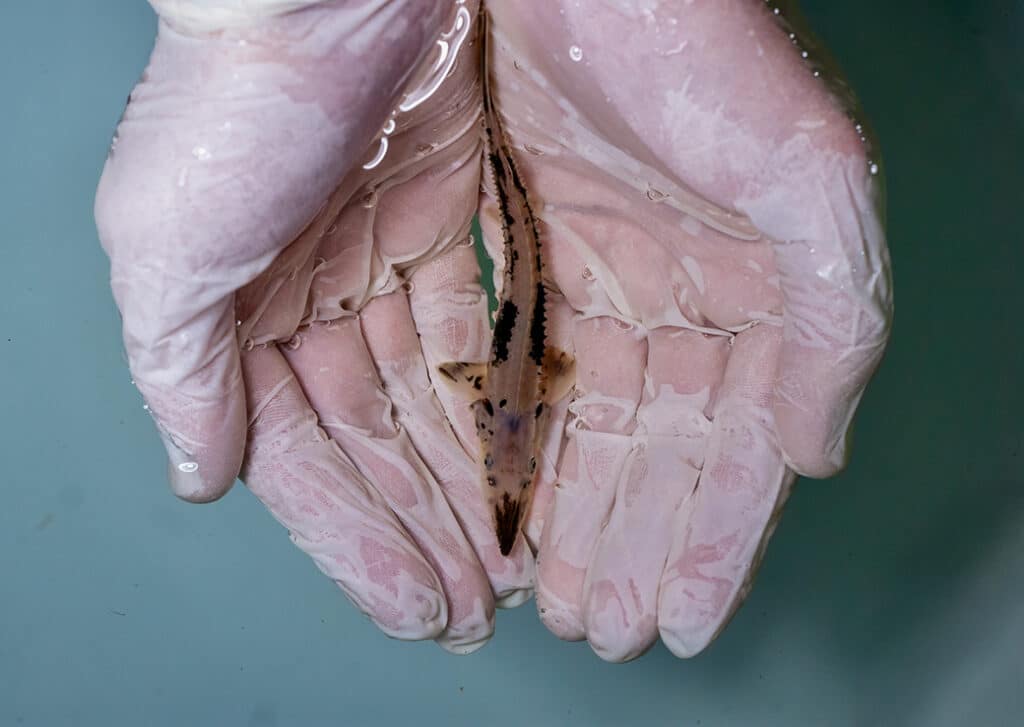
About a week later, the eggs hatched. Aquarium staff then moved the tiny fish into holding tanks filled with fresh water pumped directly from the St. Louis River. This marked the first time they raised the fish in the same waters where they will eventually live. They believe exposing the young fish to the source will help them imprint on its unique chemical and odor signature. This imprinting should help the sturgeon recognize the river and find their way back after migrating as adults.
Monitoring over summer
For the rest of the summer, staff monitored them carefully. By November, they had grown into 7-inch fingerlings — large enough, according to Walker, to have a good chance of survival.
Then, in early November, the aquarium and its partners loaded the fish into water-filled coolers. They drove a short distance to release 255 lake sturgeon into the upper and lower portions of the St. Louis River. This initiative builds on a restoration effort that began years ago after the population disappeared from the river.
For aquarium staff, the work is expected to have far-reaching impacts. “We have the opportunity to do something tangible with conservation and to have an actual effect on a species,” Walker said.

Populations wiped out in the 1950s
Two centuries ago, sturgeon were still abundant in the St. Louis River. According to a newspaper article by the Fond du Lac Band of Lake Superior Chippewa, William Johnson, a fur trader, noted in 1833, “When the sturgeon comes up to the foot of the rapids, then it is a continual feasting.” Soon after, many realized the fish’s practical benefits. Over time, they had multiple commercial uses. Not only did they taste good, but people also sought them for their swim bladders. People made isinglass, a form of collagen, from dried fish swim bladders. They used it in a variety of products, including as a clarifying agent in beer and other beverages, an adhesive in art and conservation, and an early form of gelatin.
But the populations took a hit. Walker noted that sturgeon take roughly 20 years to reach adulthood. After that, they only spawn every three to five years. Because of this, they were overfished quickly. In addition, industries like logging and steel moved in, causing pollution and essentially destroying the habitat and clean, cool waters the species depends on. Moreover, the St. Louis River has five major hydroelectric dams between Cloquet and Lake Superior that have impeded fish movement. “By the 1950s, I guess you could say, in that region, they were pretty much extirpated from the St. Louis River,” Walker added.
Then, in the 1970s, the Clean Water Act came into play, helping jumpstart initiatives to restore the river system in Duluth and other areas of the country. Enacted in 1972, the act “…establishes the basic structure for regulating discharges of pollutants into the waters of the United States and regulating quality standards for surface waters.”
Walker said that by the 1980s, the Western Lake Superior Sanitary District, now Resource Renew, had begun restoration on the St. Louis, and started formulating a plan to restock the St. Louis with sturgeon. By the late 1990s, the Fond du Lac Band worked to reintroduce sturgeon called Namewag in Ojibwe. “Fertilized eggs were placed between astroturf layers in nest boxes, and then placed in a section of rapids about 7.25 miles upstream of the confluence of the Cloquet River with the main stem of the St. Louis River,” according to an article by the Band.
It took additional restoration work by state and federal partners, but by 2008, anglers began reporting that they were catching sturgeon. After eight years of study, which included fitting some fish with radio transmitters, researchers with the Fond du Lac Band determined that the upper portions of the river could support sturgeon populations.
However, supporting the species and maintaining a naturally reproducing, self-sustaining population are two different things. Around 2011, researchers began to observe naturally reproducing sturgeon, Walker noted. But he said it wasn’t enough to sustain a population.
Aquarium supports restocking efforts
This is where the Great Lakes Aquarium stepped in to support fish-stocking efforts. According to Walker, the DNR developed a plan to restock the St. Louis River with 2,000 sturgeon each year by gathering fingerlings from Michigan and Wisconsin. However, he mentioned, the supply wasn’t always reliable. Some years, the DNR received enough fish to meet its goal; other years, it fell short. This raised an important question: Could the aquarium raise sturgeon from eggs to help the DNR consistently reach its restocking goals?
One of the biggest benefits would be raising some of the fish closer to the waters where they would eventually be released. This would also reduce the stress of transporting fish over long distances while saving money. The aquarium sits in a bay near the mouth of the St. Louis River.
As word spread about the effort, the Iron River National Fish Hatchery in Wisconsin generously provided a large trailer where the fish could be raised at the aquarium. This dedicated space kept the sturgeon separate from the aquarium’s other fish while allowing them to be raised in an environment that would better prepare them for life in the river. Plus, hatchery staff could provide helpful guidance on rearing the young fish.
“Once we had that going, we reached out to Fond du Lac Band and started that partnership, and they were really excited about the idea as well because they had gotten the fish from the same sources as well,” said Walker.


New exhibit and rearing facility underway
As a highly public-facing facility, the aquarium is also uniquely positioned to raise awareness about this important species and the efforts to restore its population.
The aquarium is currently building a 1,300-square-foot addition dedicated entirely to lake sturgeon. The main floor will house a lab with permanent space for rearing sturgeon. The second level will feature an exhibit focused on the species and restoration efforts in the St. Louis River. This will include an aquarium with juvenile sturgeon raised at the facility. It will allow viewers to see them grow larger. When they are large enough, staff will release them the following year. The addition is expected to open to the public in the fall of 2027.
The exhibit will also include stories highlighting the Fond du Lac Band’s decades-long efforts to bring back a fish long important to its history and culture. An Ojibwe artist will also contribute their creativity to a portion of the exhibit.
Restocking efforts will continue, and while the river’s sturgeon population is still relatively young, early signs are promising. According to the Duluth News Tribune, reaching a truly self-sustaining population requires three key benchmarks: a roughly equal ratio of males to females, evidence that wild-born young are surviving, and multiple generations actively maturing and reproducing—not just a handful of scattered age groups. Because lake sturgeon can live for a century or more, meeting those milestones is a long-term commitment.
Though the young sturgeon have been set off on their own, hopefully to live long and productive lives, they won’t be totally alone. The DNR microchipped all of the fish that were recently released. In subsequent years, staff will return to catch the fish, collect data, and see where they originated.
The aquarium will continue to research what does and doesn’t work to raise viable fish. The cycle will continue as the aquarium prepares to raise more sturgeon for next year’s fall restocking, hopefully in mid-October. Their goal is ambitious — to raise nearly 3,500 fish.
As he reflected on the project, Walker said, “It’s just cool to think of something that’s going to outlive you, you know, a project that you’re doing now will have an effect on something 20 years from now.”
More info:
- Sturgeon released after ‘unprecedented interagency cooperation’ – Duluth News Tribune
- Natural Resources – Sturgeon Restoration – Fond du Lac Band of Lake Superior Chippewa
- Beneficial Use Impairment Removal Recommendation for Degraded Fish and Wildlife Populations – Minnesota Department of Natural Resources
- Raised in river water: New approach to help ancient sturgeon return to Lake Superior’s headwaters – MPR News
- Nahgahchiwanong Dibahjimowinnan – Fond du Lac Band Newspaper