

Update: Burning restrictions lifted forest-wide, including the BWCAW
The Superior National Forest has lifted all campfire restrictions across the entire forest, including the BWCAW, effective 12:01 p.m. Central on August 24, according to a Forest Service news release. The agency cited cooler weather and a lower wildfire risk, and coordinated the decision with the Minnesota DNR, the Bois Forte Band of Chippewa, and the Grand Portage Band of Lake Superior Chippewa. Campgrounds and recreation areas already under closure orders remain closed. The agency is reminding people to never leave a campfire unattended and to drown, stir, and feel the ashes to confirm they’re completely cold before leaving.
Check the forest’s Alerts page and their Facebook page for the latest updates.
July 29 update:
Restrictions ease slightly in developed campgrounds
The Superior National Forest moved from Level 3 fire restrictions effective July 29 at 12:01 a.m., citing recent rain. Campfires are now allowed again in designated metal fire rings at open developed recreation sites and rustic campgrounds — a partial easing, not a lift. Restrictions remain fully in place in the BWCAW and at backcountry and dispersed campsites, where campfires are still prohibited, and any campground currently under a closure order stays closed regardless. “Having a campfire is a special part of recreating outdoors, so we are glad to be able to lift these restrictions in specific areas to offer that opportunity to the public,” said Sunny Lucas, acting Superior National Forest deputy supervisor, adding that fire danger remains moderate to high. The change was coordinated with the Minnesota DNR, the Bois Forte Band of Chippewa, and the Grand Portage Band of Lake Superior Chippewa; affected sites are listed on the Forest Service’s Alerts page.
July 20 update:
The Minnesota DNR elevated burning restrictions to Level 4 — its most restrictive tier — effective noon Monday in Cook, Lake, northern St. Louis, and Koochiching counties and a small portion of Itasca County. Under Level 4, no campfires are allowed anywhere, including on private property. Only gas or propane stoves may be used at backcountry campsites, and charcoal fires are permitted only in a device designed for them — a grill or similar — at an occupied home, cabin, or resort. Details and maps are at the DNR burning restrictions page. “We need to be able to control the controllables,” DNR agency administrator Curt Westerman said at Monday’s briefing.
July 15 update:
The campfire ban now spans the border. Ontario implemented a Restricted Fire Zone covering the entire Northwest Fire Region — including Quetico Provincial Park — effective 12:01 a.m. July 15, citing high to extreme fire danger and the need to prevent human-caused fires. Open-air burning, including campfires and fires in outdoor grates, fireplaces, and fire pits, is prohibited, and burning permits are suspended; portable gas or propane stoves may be used with extreme caution. The restriction remains in effect until further notice, according to Ontario’s Aviation, Forest Fire and Emergency Services.
July 12 update:
State fire restrictions have tightened as of today. According to the July 12 MNICS daily update, Cook, Lake, and northern St. Louis counties have burning restrictions beginning at 8 am, and campfires are not allowed in backcountry, dispersed, or remote campsites on state-managed, public, or local lands. That supersedes the earlier distinction noted by the Forest Service, under which the DNR was allowing fires within fire rings on state and private lands. Current Minnesota DNR restrictions: mndnr.gov/burnrestrictions.
The Superior National Forest’s forest-wide campfire restrictions took effect July 12 as scheduled. A fire information line is available for the July fires: 218-881-2091 (8 a.m.–8 p.m.), or 2026.JulyLightningEvent@firenet.gov.
July 11 update:
Campfire restrictions are expanding well beyond the Boundary Waters. Effective 12:01 am Sunday, July 12, the Superior National Forest’s new Fire Restriction Order (09-09-00-26-09) extends the campfire ban to all land within the forest boundary, which includes northern portions of Cook, Koochiching, Lake, and St. Louis counties. The order restricts igniting, building, maintaining, attending, or using a fire or campfire — including charcoal grills and barbecues, coal, and wood-burning stoves — and runs through October 1, 2026, or until conditions warrant a rescission. Gas or propane cook stoves remain allowed throughout the forest and in the BWCAW.
“We continue to coordinate with the Minnesota DNR, Bois Forte and Grand Portage to avoid confusion across jurisdictions. We want the recreating public to be safe as they enjoy the Forest,” said Drew Stroberg, acting Superior National Forest supervisor, in the announcement.
The Forest Service notes one key difference from the Minnesota DNR restrictions also effective July 12: on state and private lands, the DNR is allowing fires within a fire ring, while the Superior National Forest is not allowing fires anywhere within its boundary, including the BWCAW. According to the agency’s FAQ, campfires are not allowed at BWCAW fire grates, backcountry campsites, or resorts and recreation residences permitted on Forest Service land. Permanent indoor wood-burning stoves are not affected — the order applies to temporary or portable wood stoves used in tents or temporary structures. Tiki torches and bug candles are technically legal, but the agency warns that igniting them in current conditions would be irresponsible, and that a person whose use of them starts a wildfire could be federally charged and held responsible for the cost of the incident.
Voyageurs National Park is implementing parkwide fire restrictions on the same schedule — effective 12:01 am Sunday, July 12, until rescinded — citing high fire danger and active wildfires across northeast Minnesota. Campfires are prohibited throughout the park, including within designated fire rings, along with charcoal-fueled fires and grills; gas- and propane-fueled camp stoves and grills are allowed. The park says the restrictions align with broader state and regional fire management efforts. Updates are on the park’s Alerts and Conditions page.
July 10 update:
Citing continued dry conditions and wildfire activity, the Superior National Forest is issuing an Emergency Forest Order banning campfires within the Boundary Waters Canoe Area Wilderness (BWCAW), effective 12:01 a.m. Saturday, July 11, 2026, until rescinded.
The order restricts igniting, building, maintaining, attending, or using a fire or campfire — including charcoal grills and barbecues, coal, and wood-burning stoves — to reduce the likelihood of a wildfire within the wilderness. Gas or propane cook stoves are allowed throughout the BWCAW; stoves or grills fueled by charcoal or any type of wood are not.
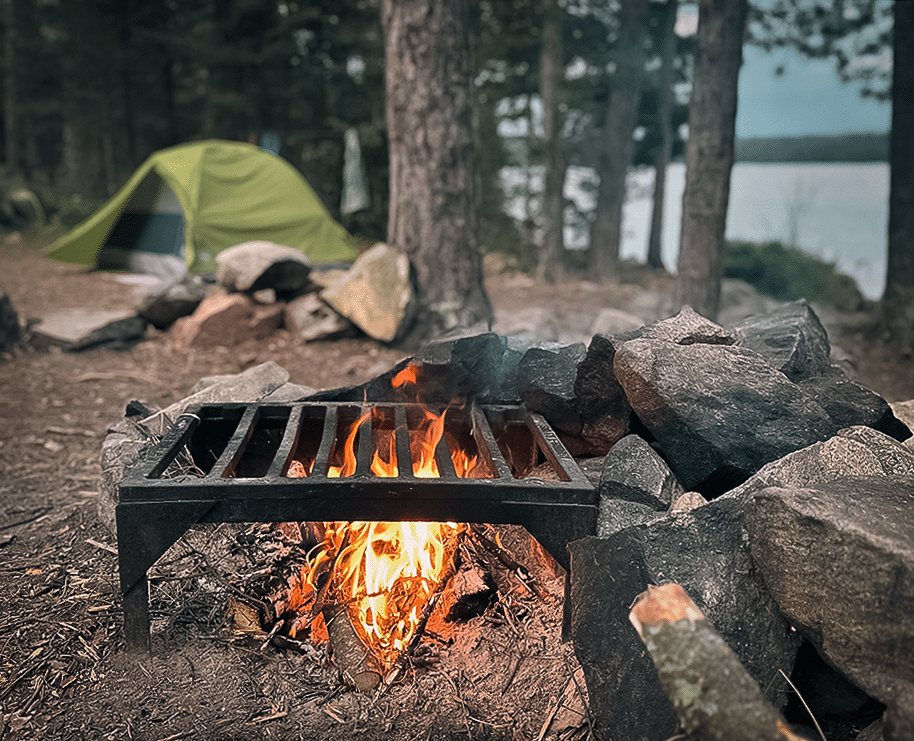
The restrictions come as the forest responds to numerous wildfires sparked since a July 6 lightning storm, including several inside the BWCAW. The Forest Service also issued an emergency closure order July 10 closing three wildfire areas in the wilderness and thirteen associated entry points, recreation sites, and trails, effective the same day.
According to the Forest Service, the potential for wildfire is currently high across northern Minnesota. The agency urges care with any sources of ignition, such as smoking devices, dragging chains, and recreational vehicles. For those in locations where campfires are permitted outside the BWCAW, the agency asks people to consider whether conditions are right and whether a fire is needed, to keep campfires small, to put them out cold to the touch before leaving, and to attend all permitted campfires at all times.
Campfire restriction information and the closure map will be posted to the forest’s Alerts page.
Get Fire Updates
Stay informed on recent wildfires, campfire bans, park closures, straight to your inbox.
More information:
- Voyageurs National Park Alerts & Conditions
- Superior National Forest Alerts (USDA Forest Service)
- Minnesota Incident Command System — statewide fire restriction information
- July 2026 Superior NF Wildfires (InciWeb)
- Superior National Forest Facebook Page