
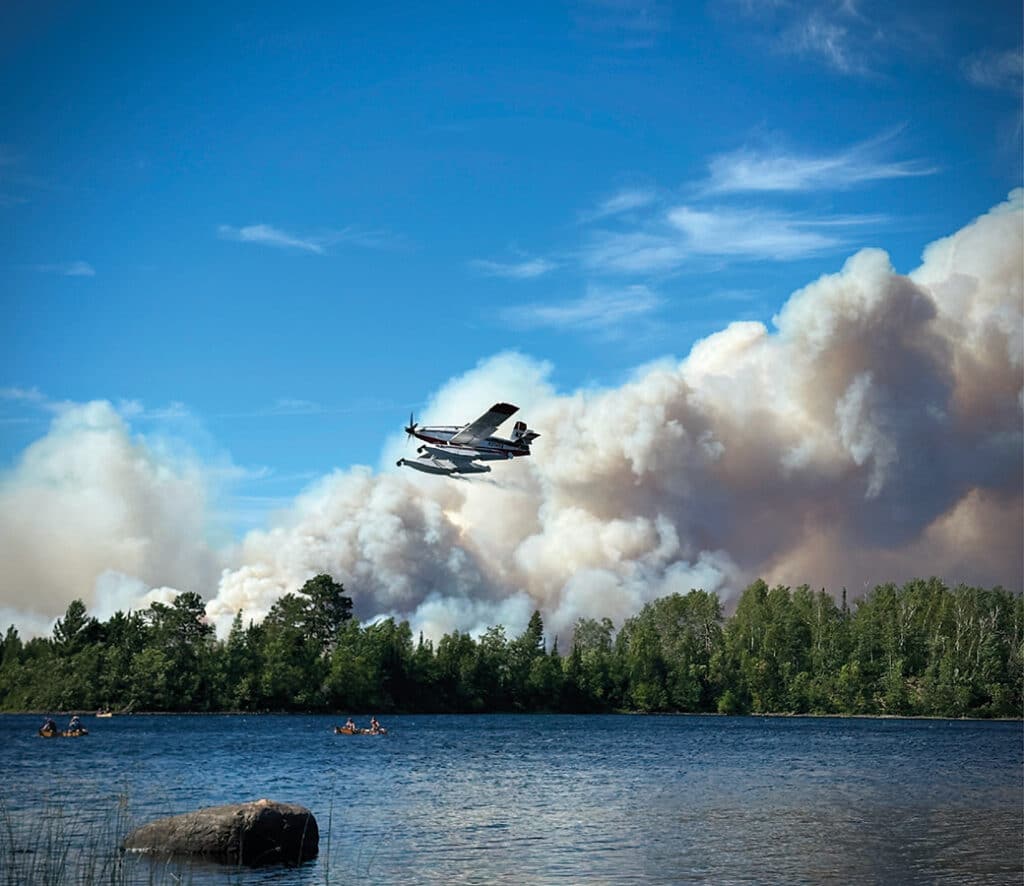
Roughly 1% of the northeastern Minnesota landscape is burned by wildfires each year. Over a 25-year period, that means about one-quarter of the landscape is affected by fire. These cyclical patterns help the forest regenerate by eliminating dead or diseased trees and overgrown vegetation, and promoting seedlings such as Jack Pine. But with rising temperatures and predictions of increasingly hot, dry summers, what does the future hold for the forest? We spoke with Minnesota ecologist and author Professor Lee E. Frelich about how climate change and future wildfires could reshape the forest.
Fire-dependent landscape
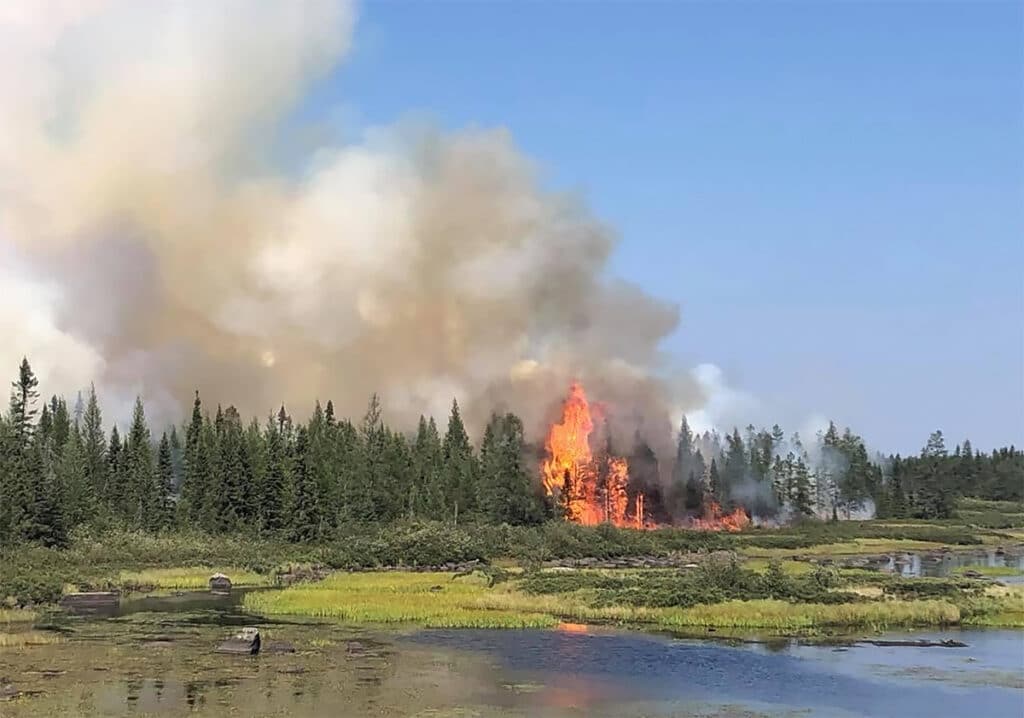
Wildfires have long been part of northern Minnesota’s landscape. This summer is no exception, with approximately 68,000 acres burning up north. This fire-dependent ecosystem relies on periodic fire to maintain a healthy forest. Wildfire reduces dead or diseased trees. It eliminates overgrown vegetation and invasive plants. Fires also help stimulate seed dispersal in trees like the Jack Pine. New areas of growth create excellent habitat for animals that browse, such as moose and deer.
According to ecologist and author Lee Frelich, this summer’s wildfires in northern Minnesota are a part of a recent 25-year cycle of increased fire activity. In fact, they’re normal, he says.
Frelich has spent decades exploring and studying the ecosystem within the Boundary Waters Canoe Area Wilderness (BWCAW). He is the director of the Center for Forest Ecology and an adjunct professor in the Department of Forest Resources at the University of Minnesota. His areas of research have included forest disturbance dynamics (such as wildfires), climate change, herbivory, and the impact of invasive earthworms.
Forest disturbances, such as wildfires, vary in both frequency and intensity. They alter the forest’s structure and composition and play an important role in shaping the ecosystem. Other types of disturbances include windstorms and insect infestations. Or, they may be human-caused, such as logging or pollution. Many can be beneficial to the forest, though not all are.

Future of the northern forests
Lee shared more about the future of the northern forest and the possibility of more wildfires. He said that he’s not surprised by this year’s wildfires. “If you look at the fire history that we have, it goes back to the late 1500s; it fits within the typical fires that we have had in the past. He added, “So if you look at the fires we’ve had starting from today and going back to about the year 2000, the total area that burned is about the same as every 25-year cycle, except from about 1910 through 1990. So in essence, we’ve returned to about the same amount of fire that was on the landscape just before European settlement.”
He also said that between about 1880 and 1920, most of the northern forests were logged. The trees that returned were almost all paper birch and aspen, which, he mentioned, are less flammable. Eventually, however, more conifers began to grow, resulting in a denser forest over the last 20 years or so. “I see the increase in fire as being related”, Frelich said. He noted that since the forests have “succeeded” or transitioned back to conifers, they are more likely to experience high-intensity fires, such as some of those we’re experiencing this summer.


Predictions indicate shifts in climate
Since 2000, Frelich said that researchers have seen a shift in overall weather patterns. The 1900s were warm and wet, which, as he mentioned, people tend to take as normal. However, he added, “it was abnormal with less fire”.
Now predictions indicate that the future forecast is warm and dry. Additionally, as temperatures and the length of the season increase, any increase in precipitation we may receive is “outstripped” by evaporation. Because of this, he says, along with the succession from logged forests to birch and aspen and eventually to conifers, future wildfire seasons are likely to be more severe than they were before.
While no one can say for sure how the wilderness will exactly evolve, Frelich says research indicates we’re going to see more fires beyond historical cycles. If the fires become too frequent, for example, nearly back-to-back, then the forest would revert to paper birch and aspen again. He cited examples of this occurring in Alaska, some parts of Canada, and Northern Scandinavia. This also has occurred in a few places in the BWCAW, where scientists have observed areas that burned 2-3 times over 30-40 years.
What ecologists like Frelich would like to see is the “sweet spot” where wildfires occur over a 50 to 100-year cycle, with about 1-2% of the northern landscape burning per year. This results in a healthy balance in the ecosystem.
Indigenous impact of surface burning
Historically, Indigenous people initiated wildfire burns particularly within red and white pine forests. This was done to open up new food sources, like blueberries, and to do so in areas they occupied and lived in. “Where they did that, they created a bubble on the landscape where if a wildfire approached, its intensity would drop,” Frelich mentioned. This usually resulted in low-intensity surface fires, similar to the planned, controlled burns the Forest Service uses today. Red and white pines can withstand these low-intensity fires. Because of Indigenous burning practices, some large stands of red pine were protected from the most destructive wildfires.
Burns intentionally set by Indigenous people also prevented fuel-loading species, such as balsam fir, from becoming too dense. Since these burns no longer occur, balsam fir stands have thickened, creating more fuel for wildfires. As a result, fires can become more intense and are more likely to kill stands of red and white pine.
Frelich says Indigenous people did not control fire over the whole landscape, they too had to deal with large, high-intensity fires as well. Notably, areas with spruce, fir, and jack pine have always experienced high-intensity fires and will continue to do so. If the future plays out like expected, those areas will return to birch and aspen.
Canada is worse off
Separately, Frelich noted that the fires up in Canada are more concerning. He mentioned their numbers have gone well beyond the normal historical patterns. For example, 45 million acres burned in 2023. Smoke from these fires has greatly impacted many areas of the United States.
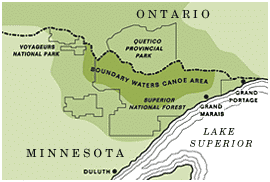
Frelich mentioned the 800,000-acre fire currently burning in Ontario, Canada, as well as another 100,000-acre fire in Quetico Provincial Park, which shares its southern boundary with the BWCAW. Currently, that park is closed to visitors, with officials hoping to open entry point stations again on August 8.
The future landscape is…savannah?
According to studies by Frelich and researchers he’s worked with, the Boundary Waters are expected to undergo major changes by 2070 and beyond. He said eventually burr oak, basswood, and red maple, which are already present, will become more dominant. The forest could also burn frequently and regenerate to birch and aspen. “There could be a lot of big changes coming in a fairly short time if we continue this trajectory of really fast warming, “he noted. If it only warms up a few degrees, the landscape would mostly remain intact. However, if the average warms by 8-10ºF, he would expect significant changes like those mentioned above. He said the eastern side of the wilderness would likely become temperate deciduous forest, and the western side, more savannah.
Some lakes may dry up, while others could become wetlands. Lakes with consistent inflows and outflows would likely remain. Overall, the water would be warmer, resulting in changes to aquatic habitats and different fish species. Exactly how a lake changes depends on several factors, including its depth.
He mentioned that the North Shore might become one exception to major changes because the cool air from Lake Superior flows inland to the crest of the Sawtooth Range. Between those areas, a boreal forest “refugia” could persist. He cited the boreal forest refugia near Bailey’s Harbor in Door County, Wisconsin, where, thousands of years ago, the area transitioned to a temperate forest. Because of the cooling effects of Lake Michigan, about 20,000 acres on the east side of the Door Peninsula are part of a cool-climate ecosystem.


What needs to change, what to expect
Ultimately, he believes that the only way to slow, or possibly halt, changes in the wilderness is to lower carbon emissions. He also suggested that geoengineering could help keep the climate cool while society transitions to renewable energy sources and advances carbon removal technology. Frelich believes all three strategies will help. But, he added, “I don’t think the transition to renewable energy will happen fast enough by itself to prevent major changes around the world.”
He said, regardless, they have a pretty good idea, based on models, of what will happen under a high-warming scenario and a low-warming scenario.
What seems certain, according to Frelich, is that we will see more wildfires within and outside of the wilderness. Some will be smaller while others may be quite large or “mega fires” burning over hundreds of thousands of acres. Historically, there were mega fires in northern Minnesota in the late 1700s and in 1863-1864.
Frelich said that if northern Minnesota hadn’t received rain after the wildfires intensified, “we could have had a couple of 100,000-acre fires in the Boundary Waters by now.”
In the end, Frelich sees the latest patterns as normal — for now. “If you look through the last 400 years in the Boundary Waters, this amount of fire we’ve had with the Ham Lake, Cavity Lake and Pagami Creek Fires, and now these fires this year, is historically normal.”
Whether that pattern continues remains to be seen, especially as summers grow warmer and wildfires are expected to burn into the winter.

More info:
- Lee Frelich – The Future of the Boreal Forest
- USFS-Superior National Forest – Alerts
- Quetico Provincial Park – Alerts
- Climate Impacts in the Midwest – United States Environmental Protection Agency