GPS-Collar Moose Study Underway
In an on-going effort to understand the reasons behind decline in Minnesota’s moose population, a study using global positioning system technology to track the massive ungulates in underway.
A lawsuit brought by two Minnesotans and joined by the state’s Department of Natural Resources calling of removal of Upper Midwest wolves from the federal Endangered Species List has been stayed until June.
Minnesota senator Amy Klobuchar says the U.S. Fish and Wildlife Service will remove Minnesota’s gray wolves from the Endangered Species list by the end of next year.
The U.S. Fish and Wildlife Service will try again to remove gray wolves from the endangered species list in Minnesota, Wisconsin and Michigan’s Upper Peninsula. The USFWS has tried three other times return wolves to state and tribal management, only to be stymied in court.
Three campsites in Voyageurs National Park that were off-limits due to blad eagles nesting in close proximity have been re-opened, the Park announced recently.
A petition by the Center for Biological Diversity asks the U.S. Fish and Wildlife Service to continue endangered species protection on wolves in the Great Lakes and Rocky Mountains until the predators have expanded their territory to more of the United States.
The Minnesota Department of Natural Resources and the U.S. Army Corps of Engineers may redo their Draft Environmental Impact Statement for the PolyMet copper-nickel mining operation proposed near Babbitt. The original Draft EIS was declared “environmentally unsatisfactory-inadequate” by the federal Environmental Protection Agency earlier this year.
Voyageurs National Park announced the closure of three developed campsites and three undeveloped areas due to the presence of active bald eagle nests. The restrictions come under the auspices of the Bald Eagle and Golden Eagle Management Act.
As anticipated, a suit to remove Minnesota wolves from the federal Endangered Species List and to return management of the animals to the state has been filed in federal district count.
The Minnesota Department of Natural Resources has filed the petition with the U.S. Department of the Interior arguing that the gray wolf should be immediately removed from the federal government’s endangered and threatened species list and returned to state management.
A growing chorus in favor of removal of the eastern gray wolf from the federal Endangered Species List could culminate in a lawsuit to force the U.S. Fish and Wildlife Service to turn management of the species over to state agencies.
Grey wolves in Minnesota were recently put back on the federal endangered species list. The U.S. Fish and Wildlife Service published a notice last week formally re-establishing the animals’ protected status.
A northern Minnesota resident writes about her concerns over the declineing moose population in northeastern Minnesota. She outlines the steps moose experts believe are needed to support one of the Quetico-Superior’s signature species.
As Voyageurs National Park reopens eagle nesting sites closed to visitor use, the park reports a general increase in successful breeding and the overall health of the VNP eagle population.
Two weeks ago, five wildlife protection groups filed a complaint against the removal of Great Lakes Wolves from the Endangered Species List. Today, wolves are back under federal protection as the …
Five wildlife protection groups have filed a complaint in Federal District Court challenging the removal of federal Endangered Species Act protections for gray wolves in the Upper Midwest.
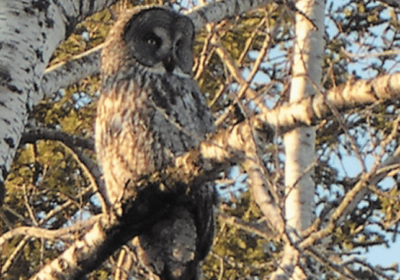
by Anthony X. Hertzel Minnesota Ornithologists’ Union In the fall and winter of 2004-2005, Great Gray Owls moved into northern Minnesota in unprecedented numbers. By the end of the winter season, …
The 1999 blowdown in the BWCAW damaged many acres of undisturbed boreal forest, destroying the nesting habitats for
many species of birds. The Three-toed Woodpecker, (Picoides tridactylus) however, is benefiting from this disturbance twofold. Their preferred habitat is disturbed areas within coniferous forests, but recentlyburned conifers are an added attraction. Damaged conifers become home to many insects, and this abundant food source attracts Three-toed Woodpeckers.